Recipes · American · Appetizers
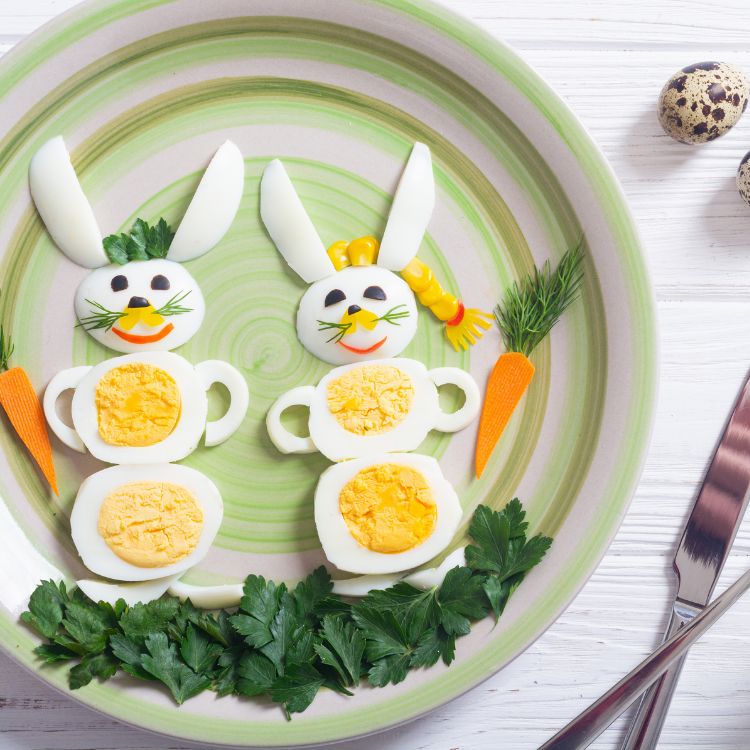
Bunny Egg Plate
One serving has 193 kcal and 14 g protein, and at least a fifth of a woman's daily need of vitamin K (95%), choline (70%), selenium (59%), vitamin A (53%), riboflavin (52%) and cobalamin (48%). Ready in 25 minutes.
- Preparation: 15 min
- Cooking: 10 min
- Makes: 1 serving (145 g)
- Difficulty: Easy
- Diets: Paleo, Vegetarian, Kosher, Halal
- Contains: dairy, egg
Ingredients
- 100 g Egg, whole, cooked, hard-boiled
- 10 g Carrots, raw
- 5 g Olives, black
- 5 g Parsley, fresh
- 2 g Dill weed, fresh
- 5 g Cheese, Cheddar
- 5 g Peppers, bell, red, raw
- 3 g Dill weed, fresh
- 10 g Carrots, raw
Method
- Boil the Eggs: Place the eggs in a small pot and cover them with water. Bring the water to a boil, then let the eggs cook for 10 minutes. Once boiled, cool the eggs under cold water and peel the shell.
- Prepare the Bunnies: Body and Head: Slice each boiled egg into three pieces – two halves for the body and one slice for the head. Ears: Cut egg white slices from one of the eggs to form bunny ears. Place them above the head of each bunny. Face: Cut small pieces of black olive (5g) to create the eyes of the bunnies. Use small pieces of carrot (10g) to make the bunny noses. Cut a small slice of red bell pepper (2g) for each bunny’s smile. Arrange a few dill sprigs (2g) as bunny whiskers around the nose.
- Decorate the Body: Arrange two egg halves per bunny to form the body. Cheese Stick Bow: Use a small piece of cheese stick (5g) to create a bow for one of the bunny heads.
- Add Garnishes: Place fresh parsley (5g) along the bottom of the plate for a green grassy effect. Add a small decorative carrot, carved from the remaining carrot pieces (10g). Use additional dill sprigs (3g) for a decorative touch.
Nutrition per serving
| Nutrient | Per serving | Share of a day's need |
|---|---|---|
| Energy | 193 kcal | 9% |
| Carbohydrates | 4.5 g | |
| Water | 111 mL | |
| Fiber | 0.97 g | 3% |
| Protein | 14.3 g | 30% |
| Tryptophan | 0.16 g | |
| Threonine | 0.61 g | |
| Isoleucine | 0.7 g | |
| Leucine | 1.1 g | |
| Lysine | 0.93 g | |
| Methionine | 0.39 g | |
| Cystine | 0.29 g | |
| Phenylalanine | 0.68 g | |
| Tyrosine | 0.52 g | |
| Valine | 0.78 g | |
| Histidine | 0.3 g | |
| Fat | 13 g | |
| Monounsaturated | 4.9 g | |
| Polyunsaturated | 1.5 g | |
| Docosahexaenoic Acid (DHA) | 0.04 g | |
| Eicosapentaenoic Acid (EPA) | 0.01 g | |
| Omega-6 | 1.3 g | |
| Saturated | 4.4 g | |
| Trans-Fats | 0 g | |
| Cholesterol | 378 mg | |
| Calcium | 114 mg | 11% |
| Copper | 0.05 mg | 6% |
| Iron | 2.2 mg | 12% |
| Magnesium | 19.8 mg | 6% |
| Manganese | 0.1 mg | 6% |
| Phosphorus | 210 mg | 30% |
| Potassium | 269 mg | 6% |
| Selenium | 32.3 µg | 59% |
| Sodium | 213 mg | |
| Zinc | 1.4 mg | 18% |
| Thiamin (vitamin B1) | 0.09 mg | 8% |
| Riboflavin (vitamin B2) | 0.57 mg | 52% |
| Niacin (vitamin B3) | 0.46 mg | 3% |
| Pantothenic acid (vitamin B5) | 1.4 mg | 29% |
| Pyridoxine (vitamin B6) | 0.18 mg | 14% |
| Folate (vitamin B9) | 66.3 µg | 17% |
| Cobalamin (vitamin B12) | 1.2 µg | 48% |
| Choline | 298 mg | 70% |
| Vitamin A | 373 µg | 53% |
| Vitamin C | 19.2 mg | 26% |
| Vitamin D (D2 + D3) | 87 IU | 14% |
| Vitamin E | 1.3 mg | 9% |
| Vitamin K | 85.1 µg | 95% |
Shares of a day's need are for a woman of 30, 165 cm, 60 kg, lightly active, by the US and Canadian Dietary Reference Intakes. SustainBite works out each person's own needs, by the standard where they live: the Nordic Nutrition Recommendations in Norway, the UK's, EFSA's in the EU.
Climate footprint
0.3 kg CO2e a serving: about average for breakfasts, sides, desserts and drinks on SustainBite. Source: ADEME, Agribalyse 3.2.
Plan weeks of recipes like this on SustainBite: meals that meet each person's vitamin and mineral needs, for a family too, with one grocery list. Free.