Recipes · Greek · Gluten-Free Dishes
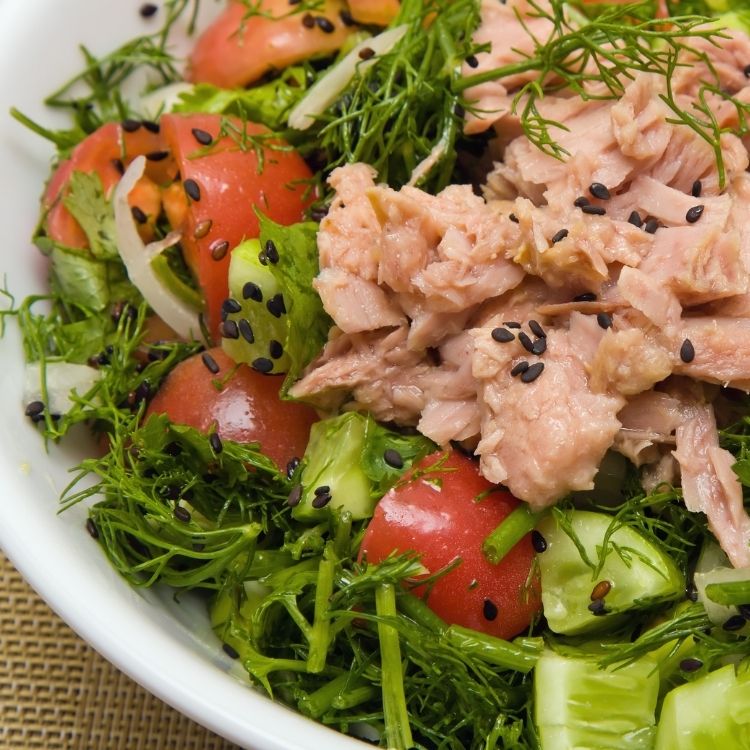
Tuna Salad with Tomatoes, Cucumber, and Dill
One serving has 326 kcal and 41 g protein, and at least a fifth of a woman's daily need of selenium (223%), cobalamin (187%), niacin (148%), pyridoxine (49%), phosphorus (45%) and vitamin C (30%). Ready in 10 minutes.
- Preparation: 10 min
- Makes: 1 serving (297 g)
- Difficulty: Easy
- Diets: Anti-Inflammatory Diet, Dairy-free, High protein, Mediterranean, Halal, Kosher
- Contains: fish, sesame
Ingredients
- 150 g Fish, tuna, light, canned in water, without salt, drained solids
- 50 g Tomatoes, raw
- 50 g Cucumber, raw
- 10 g Dill weed, fresh
- 10 g Onions, raw
- 5 g Sesame seeds
- 10 g Olive oil
- 10 g Lemon juice, raw
- 1 g Salt, table
- 1 g Spices, pepper, black
Method
- Prepare the Ingredients Open the canned tuna and drain the water or oil completely to get a final weight of 150g. Chop the tomatoes into bite-sized pieces and dice the cucumber. Thinly slice the red onion and finely chop the fresh dill.
- Assemble the Salad In a large mixing bowl, combine the drained tuna (150g), chopped tomatoes, diced cucumber, and red onion. Sprinkle in the freshly chopped dill.
- Season and Mix Drizzle the olive oil and lemon juice over the salad. Add a pinch of salt and freshly ground black pepper to taste. Gently toss everything together until well combined.
- Garnish and Serve Transfer the salad to a serving plate or bowl. Sprinkle black sesame seeds on top for added crunch and visual appeal. Serve immediately and enjoy your fresh, flavorful salad.
- Chef's Tips Draining Tuna: Use a fine-mesh strainer to ensure all excess water or oil is removed. Freshness Tip: Use ripe tomatoes and crisp cucumbers for the best texture and taste. Extra Greens: You can add arugula or baby spinach for additional nutrients. Make It Zesty: For more tang, add extra lemon juice or a pinch of lemon zest.
Nutrition per serving
| Nutrient | Per serving | Share of a day's need |
|---|---|---|
| Energy | 326 kcal | 15% |
| Carbohydrates | 7.4 g | |
| Water | 235 mL | |
| Fiber | 2.1 g | 7% |
| Protein | 40.6 g | 85% |
| Tryptophan | 0.43 g | |
| Threonine | 1.7 g | |
| Isoleucine | 1.8 g | |
| Leucine | 3.1 g | |
| Lysine | 3.5 g | |
| Methionine | 1.1 g | |
| Cystine | 0.41 g | |
| Phenylalanine | 1.5 g | |
| Tyrosine | 1.3 g | |
| Valine | 2 g | |
| Histidine | 1.1 g | |
| Fat | 14.7 g | |
| Monounsaturated | 8.4 g | |
| Polyunsaturated | 2.8 g | |
| Docosahexaenoic Acid (DHA) | 0.33 g | |
| Eicosapentaenoic Acid (EPA) | 0.07 g | |
| Omega-6 | 2.2 g | |
| Saturated | 2.4 g | |
| Trans-Fats | 0 g | |
| Cholesterol | 45 mg | |
| Calcium | 61 mg | 6% |
| Copper | 0.23 mg | 26% |
| Iron | 3.7 mg | 21% |
| Magnesium | 78.1 mg | 25% |
| Manganese | 0.29 mg | 16% |
| Phosphorus | 313 mg | 45% |
| Potassium | 673 mg | 14% |
| Selenium | 123 µg | 223% |
| Sodium | 475 mg | |
| Zinc | 1.8 mg | 22% |
| Thiamin (vitamin B1) | 0.13 mg | 12% |
| Riboflavin (vitamin B2) | 0.18 mg | 16% |
| Niacin (vitamin B3) | 20.8 mg | 148% |
| Pantothenic acid (vitamin B5) | 0.4 mg | 8% |
| Pyridoxine (vitamin B6) | 0.64 mg | 49% |
| Folate (vitamin B9) | 40.8 µg | 10% |
| Cobalamin (vitamin B12) | 4.5 µg | 187% |
| Choline | 9 mg | 2% |
| Vitamin A | 57.5 µg | 8% |
| Vitamin C | 22.7 mg | 30% |
| Vitamin D (D2 + D3) | 0 IU | 0% |
| Vitamin E | 2.5 mg | 17% |
| Vitamin K | 16.2 µg | 18% |
Shares of a day's need are for a woman of 30, 165 cm, 60 kg, lightly active, by the US and Canadian Dietary Reference Intakes. SustainBite works out each person's own needs, by the standard where they live: the Nordic Nutrition Recommendations in Norway, the UK's, EFSA's in the EU.
Climate footprint
1 kg CO2e a serving: about average for main dishes on SustainBite. Source: ADEME, Agribalyse 3.2.
Plan weeks of recipes like this on SustainBite: meals that meet each person's vitamin and mineral needs, for a family too, with one grocery list. Free.