Recipes · Russian · Pies
Pirog (Cabbage Pirog)
One serving has 348 kcal and 10 g protein, and at least a fifth of a woman's daily need of vitamin K (94%), thiamin (55%), vitamin C (55%), folate (45%), riboflavin (42%) and selenium (41%). Ready in 110 minutes.
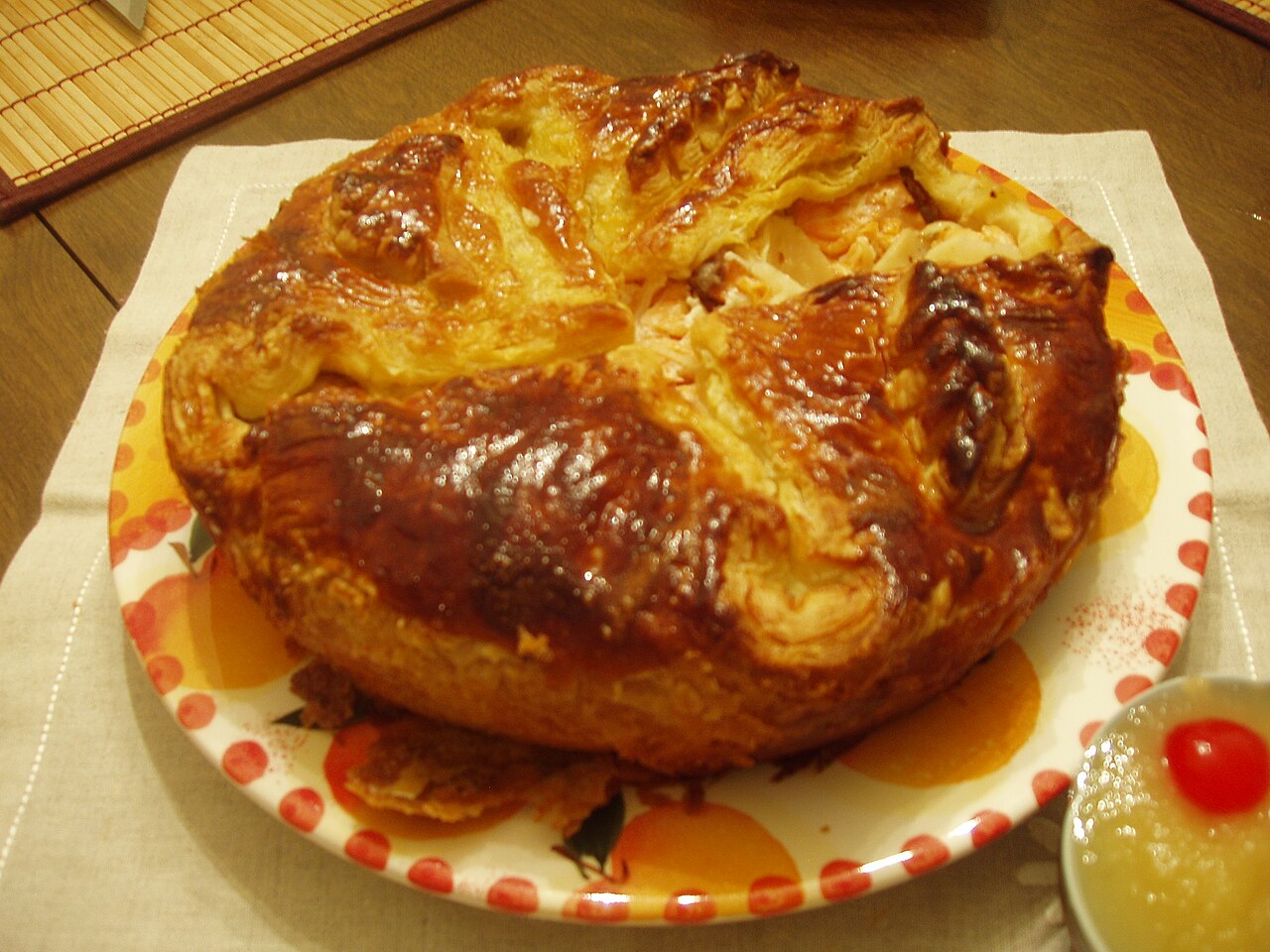

- Preparation: 75 min
- Cooking: 35 min
- Makes: 1 serving (230 g)
- Difficulty: Medium
- Diets: Vegetarian
- Contains: dairy, egg, gluten
Ingredients
- 45 g Flour, all-purpose
- 20 g Milk, whole
- 12 g Butter, unsalted
- 1.5 g Yeast, active dry
- 20 g Eggs, whole, raw
- 5 g Sugar
- 1 g Salt
- 110 g Cabbage, green, raw
- 15 g Onions, raw
Method
- Warm the milk, dissolve the yeast and sugar in it, and let stand for 10 minutes until foamy; mix in the flour, salt, half the butter and half the beaten egg to a soft dough, knead for 8 minutes, then cover and let rise for 1 hour. Makes 1 of 8 slices of a whole pirog; multiply the recipe by 8 for a full pie serving 8.
- Meanwhile, finely shred the cabbage and finely chop the onion.
- Melt the remaining butter in a pan, add the onion and cabbage with a pinch of salt, and cook over medium heat for 12-15 minutes, stirring often, until soft and lightly golden; cool.
- Boil the remaining egg for 9 minutes, cool, peel, chop and stir it into the cooled cabbage.
- Roll out two-thirds of the risen dough to line a pie dish, fill with the cabbage mixture, then roll the rest of the dough for a lid; seal the edges and cut a steam vent.
- Brush with the remaining beaten egg and bake at 190 C (375 F) for 30-35 minutes until deep golden.
- Cool for 10 minutes before slicing; serve warm or at room temperature.
Nutrition per serving
| Nutrient | Per serving | Share of a day's need |
|---|---|---|
| Energy | 348 kcal | 16% |
| Carbohydrates | 48.9 g | |
| Water | 155 mL | |
| Fiber | 4.6 g | 16% |
| Protein | 10.1 g | 21% |
| Tryptophan | 0.12 g | |
| Threonine | 0.34 g | |
| Isoleucine | 0.4 g | |
| Leucine | 0.7 g | |
| Lysine | 0.45 g | |
| Methionine | 0.2 g | |
| Cystine | 0.18 g | |
| Phenylalanine | 0.47 g | |
| Tyrosine | 0.32 g | |
| Valine | 0.49 g | |
| Histidine | 0.23 g | |
| Fat | 13 g | |
| Monounsaturated | 3.8 g | |
| Polyunsaturated | 0.99 g | |
| Docosahexaenoic Acid (DHA) | 0.01 g | |
| Eicosapentaenoic Acid (EPA) | 0 g | |
| Omega-6 | 0.75 g | |
| Saturated | 7.2 g | |
| Trans-Fats | 0.01 g | |
| Cholesterol | 102 mg | |
| Calcium | 91.6 mg | 9% |
| Copper | 0.12 mg | 13% |
| Iron | 3 mg | 17% |
| Magnesium | 30.1 mg | 10% |
| Manganese | 0.52 mg | 29% |
| Phosphorus | 150 mg | 21% |
| Potassium | 328 mg | 7% |
| Selenium | 22.8 µg | 41% |
| Sodium | 448 mg | |
| Zinc | 1 mg | 13% |
| Thiamin (vitamin B1) | 0.61 mg | 55% |
| Riboflavin (vitamin B2) | 0.46 mg | 42% |
| Niacin (vitamin B3) | 3.6 mg | 26% |
| Pantothenic acid (vitamin B5) | 1.1 mg | 21% |
| Pyridoxine (vitamin B6) | 0.24 mg | 18% |
| Folate (vitamin B9) | 178 µg | 45% |
| Cobalamin (vitamin B12) | 0.29 µg | 12% |
| Choline | 77 mg | 18% |
| Vitamin A | 129 µg | 18% |
| Vitamin C | 41.4 mg | 55% |
| Vitamin D (D2 + D3) | 26.6 IU | 4% |
| Vitamin E | 0.77 mg | 5% |
| Vitamin K | 84.8 µg | 94% |
Shares of a day's need are for a woman of 30, 165 cm, 60 kg, lightly active, by the US and Canadian Dietary Reference Intakes. SustainBite works out each person's own needs, by the standard where they live: the Nordic Nutrition Recommendations in Norway, the UK's, EFSA's in the EU.
Climate footprint
0.3 kg CO2e a serving: about average for breakfasts, sides, desserts and drinks on SustainBite. Source: ADEME, Agribalyse 3.2.
Plan weeks of recipes like this on SustainBite: meals that meet each person's vitamin and mineral needs, for a family too, with one grocery list. Free.