Recipes · German · Cakes
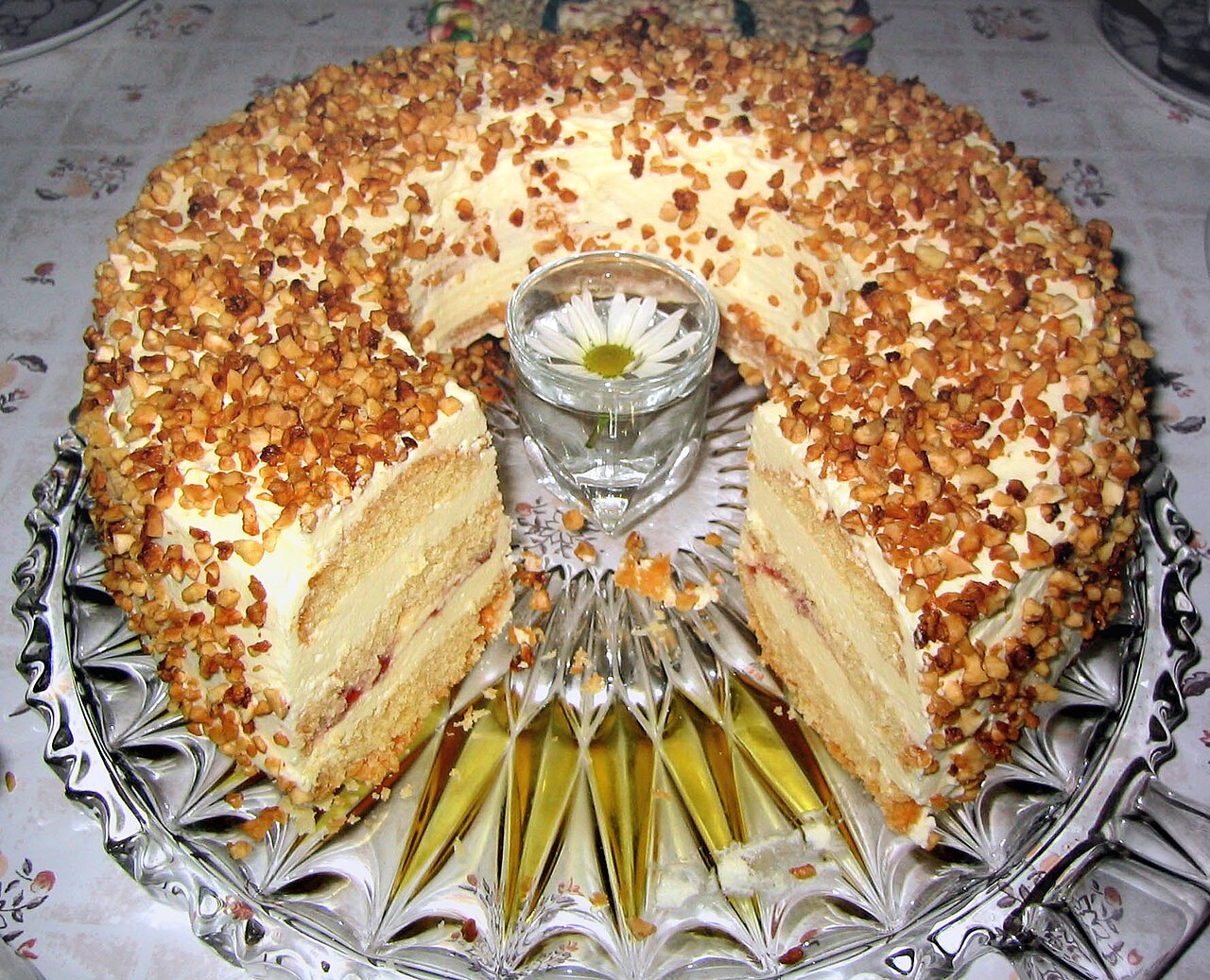
Frankfurter Kranz
One serving has 543 kcal and 10 g protein, and at least a fifth of a woman's daily need of riboflavin (43%), phosphorus (41%), selenium (36%), vitamin A (34%), vitamin E (32%) and manganese (29%). Ready in 90 minutes.

- Preparation: 45 min
- Cooking: 45 min
- Makes: 1 serving (147 g)
- Difficulty: Hard
- Diets: Vegetarian
- Contains: alcohol, dairy, egg, gluten, nut
Ingredients
- 25 g Flour, all-purpose
- 25 g Butter, unsalted
- 22 g Sugar
- 22 g Eggs, whole, raw
- 1 g Baking powder
- 20 g Milk, whole
- 5 g Egg yolks, raw
- 3 g Cornstarch
- 15 g Almonds
- 8 g Candied fruit
- 1 g Vanilla extract
Method
- Makes 1 slice; multiply the ingredients by 12 for a whole ring cake baked in a kranz (ring) tin. Cream half the butter with half the sugar until fluffy, beat in the eggs, then fold in the flour and baking powder.
- Spoon into a greased ring tin and bake at 175 °C (350 °F) for 30-35 minutes until springy and golden; cool completely, then slice horizontally into two or three rings.
- Make the custard: whisk the egg yolk with a little of the remaining sugar and the cornstarch, pour on the hot milk, return to the pan and cook over medium heat, whisking, until thick; stir in the vanilla and cool completely.
- Beat the remaining butter until fluffy, then beat in the cooled custard a spoonful at a time to make a smooth buttercream.
- Toast the almonds in a dry pan, then caramelize with the remaining sugar over medium heat until golden praline; cool and chop finely.
- Sandwich the sponge rings back together with some of the buttercream, then spread the rest over the outside.
- Press the chopped almond praline all over the sides and top of the ring.
- Decorate the top with the candied fruit (glacé cherries) arranged in a ring, and chill briefly before cutting a slice.
Nutrition per serving
| Nutrient | Per serving | Share of a day's need |
|---|---|---|
| Energy | 543 kcal | 26% |
| Carbohydrates | 55.3 g | |
| Water | 46.8 mL | |
| Fiber | 2.7 g | 9% |
| Protein | 10.2 g | 21% |
| Tryptophan | 0.12 g | |
| Threonine | 0.35 g | |
| Isoleucine | 0.44 g | |
| Leucine | 0.79 g | |
| Lysine | 0.47 g | |
| Methionine | 0.19 g | |
| Cystine | 0.17 g | |
| Phenylalanine | 0.53 g | |
| Tyrosine | 0.33 g | |
| Valine | 0.52 g | |
| Histidine | 0.25 g | |
| Fat | 32.1 g | |
| Monounsaturated | 12.2 g | |
| Polyunsaturated | 3.4 g | |
| Docosahexaenoic Acid (DHA) | 0.02 g | |
| Eicosapentaenoic Acid (EPA) | 0 g | |
| Omega-6 | 3 g | |
| Saturated | 14.8 g | |
| Trans-Fats | 0.01 g | |
| Cholesterol | 192 mg | |
| Calcium | 167 mg | 17% |
| Copper | 0.23 mg | 26% |
| Iron | 2.4 mg | 13% |
| Magnesium | 52.3 mg | 17% |
| Manganese | 0.52 mg | 29% |
| Phosphorus | 285 mg | 41% |
| Potassium | 211 mg | 4% |
| Selenium | 19.9 µg | 36% |
| Sodium | 133 mg | |
| Zinc | 1.1 mg | 14% |
| Thiamin (vitamin B1) | 0.26 mg | 24% |
| Riboflavin (vitamin B2) | 0.47 mg | 43% |
| Niacin (vitamin B3) | 2.1 mg | 15% |
| Pantothenic acid (vitamin B5) | 0.77 mg | 15% |
| Pyridoxine (vitamin B6) | 0.09 mg | 7% |
| Folate (vitamin B9) | 71.7 µg | 18% |
| Cobalamin (vitamin B12) | 0.43 µg | 18% |
| Choline | 121 mg | 29% |
| Vitamin A | 235 µg | 34% |
| Vitamin C | 0 mg | 0% |
| Vitamin D (D2 + D3) | 39.1 IU | 7% |
| Vitamin E | 4.9 mg | 32% |
| Vitamin K | 2 µg | 2% |
Shares of a day's need are for a woman of 30, 165 cm, 60 kg, lightly active, by the US and Canadian Dietary Reference Intakes. SustainBite works out each person's own needs, by the standard where they live: the Nordic Nutrition Recommendations in Norway, the UK's, EFSA's in the EU.
Climate footprint
0.4 kg CO2e a serving: higher than most breakfasts, sides, desserts and drinks on SustainBite. Source: ADEME, Agribalyse 3.2.
Plan weeks of recipes like this on SustainBite: meals that meet each person's vitamin and mineral needs, for a family too, with one grocery list. Free.