Recipes · Japanese · Soups and Broths
Tonkotsu Ramen (Pork Bone Broth Noodles)
One serving has 795 kcal and 49 g protein, and at least a fifth of a woman's daily need of selenium (193%), thiamin (95%), riboflavin (71%), niacin (68%), cobalamin (64%) and phosphorus (62%). Ready in 500 minutes.
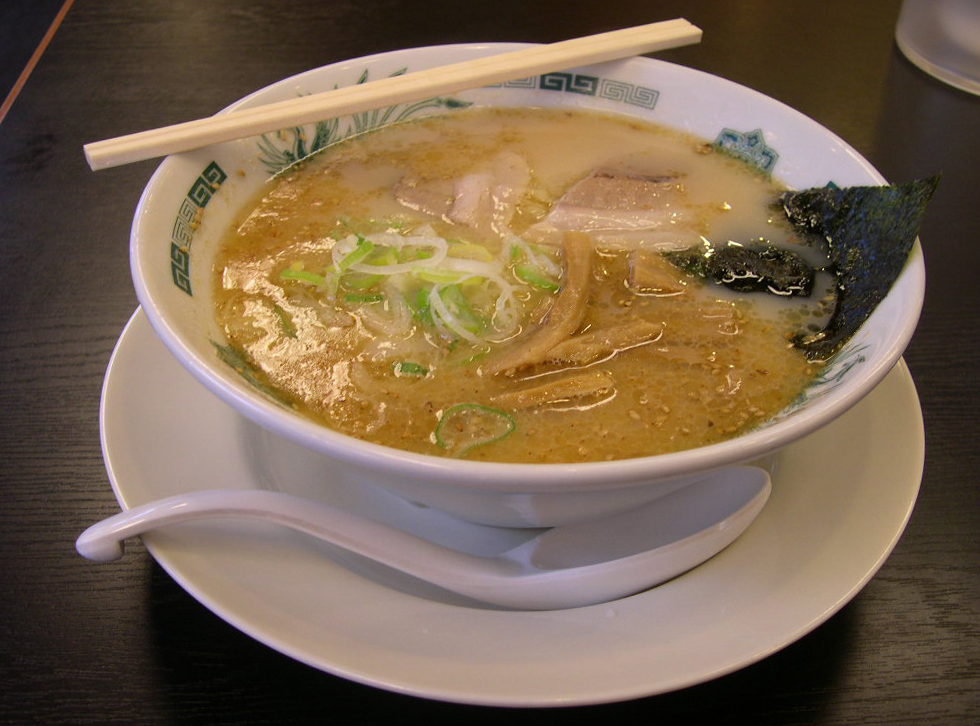

- Preparation: 20 min
- Cooking: 480 min
- Makes: 1 serving (729 g)
- Difficulty: Hard
- Diets: Dairy-free, High protein
- Contains: egg, gluten, pork, soy
Ingredients
- 120 g Pork feet, raw
- 8 g Garlic, raw
- 6 g Ginger, fresh
- 75 g Egg noodles, dry
- 30 g Pork belly, raw
- 10 g Soy sauce
- 50 g Eggs, whole, raw
- 10 g Scallions, raw
- 420 g Water
Method
- Blanch the pork trotters in boiling water for 5 minutes to remove impurities, then drain and rinse well.
- Return the trotters to a clean pot with the garlic, ginger and about 420 g water for one bowl (enough to cover generously; scale up proportionally, roughly 2-2.5 L per kg of trotters, if simmering a bigger pot for several bowls); bring to a boil, then simmer hard, uncovered, for 7-8 hours, topping up water as needed, until the broth turns rich, cloudy and milky-white.
- Separately, simmer the pork belly in a little of the broth with half the soy sauce for 45-60 minutes until tender, then slice.
- Soft-boil the egg for 6-7 minutes, cool in cold water, peel and halve.
- Strain the finished broth, season with the remaining soy sauce, and bring to a simmer; cook the noodles separately in boiling water until tender, then drain.
- Divide the noodles between bowls, ladle the hot broth over, and top with the sliced pork belly, soft-boiled egg and scallion.
Nutrition per serving
| Nutrient | Per serving | Share of a day's need |
|---|---|---|
| Energy | 795 kcal | 38% |
| Carbohydrates | 58.8 g | |
| Water | 579 mL | |
| Fiber | 3.1 g | 10% |
| Protein | 49.1 g | 102% |
| Tryptophan | 0.2 g | |
| Threonine | 0.65 g | |
| Isoleucine | 0.84 g | |
| Leucine | 1.5 g | |
| Lysine | 0.85 g | |
| Methionine | 0.41 g | |
| Cystine | 0.38 g | |
| Phenylalanine | 0.96 g | |
| Tyrosine | 0.51 g | |
| Valine | 1 g | |
| Histidine | 0.47 g | |
| Fat | 39.3 g | |
| Monounsaturated | 17.8 g | |
| Polyunsaturated | 5 g | |
| Docosahexaenoic Acid (DHA) | 0.03 g | |
| Eicosapentaenoic Acid (EPA) | 0 g | |
| Omega-6 | 4.4 g | |
| Saturated | 12.6 g | |
| Trans-Fats | 0.06 g | |
| Cholesterol | 376 mg | |
| Calcium | 178 mg | 18% |
| Copper | 0.45 mg | 50% |
| Iron | 5.2 mg | 29% |
| Magnesium | 76.1 mg | 25% |
| Manganese | 0.92 mg | 51% |
| Phosphorus | 437 mg | 62% |
| Potassium | 511 mg | 11% |
| Selenium | 106 µg | 193% |
| Sodium | 825 mg | |
| Zinc | 3.6 mg | 45% |
| Thiamin (vitamin B1) | 1.1 mg | 95% |
| Riboflavin (vitamin B2) | 0.78 mg | 71% |
| Niacin (vitamin B3) | 9.4 mg | 68% |
| Pantothenic acid (vitamin B5) | 2 mg | 40% |
| Pyridoxine (vitamin B6) | 0.48 mg | 37% |
| Folate (vitamin B9) | 217 µg | 54% |
| Cobalamin (vitamin B12) | 1.5 µg | 64% |
| Choline | 212 mg | 50% |
| Vitamin A | 98.7 µg | 14% |
| Vitamin C | 4.8 mg | 6% |
| Vitamin D (D2 + D3) | 49.3 IU | 8% |
| Vitamin E | 1 mg | 7% |
| Vitamin K | 21.4 µg | 24% |
Shares of a day's need are for a woman of 30, 165 cm, 60 kg, lightly active, by the US and Canadian Dietary Reference Intakes. SustainBite works out each person's own needs, by the standard where they live: the Nordic Nutrition Recommendations in Norway, the UK's, EFSA's in the EU.
Climate footprint
1 kg CO2e a serving: about average for main dishes on SustainBite. Source: ADEME, Agribalyse 3.2.
Plan weeks of recipes like this on SustainBite: meals that meet each person's vitamin and mineral needs, for a family too, with one grocery list. Free.