Recipes · Turkish · Appetizers
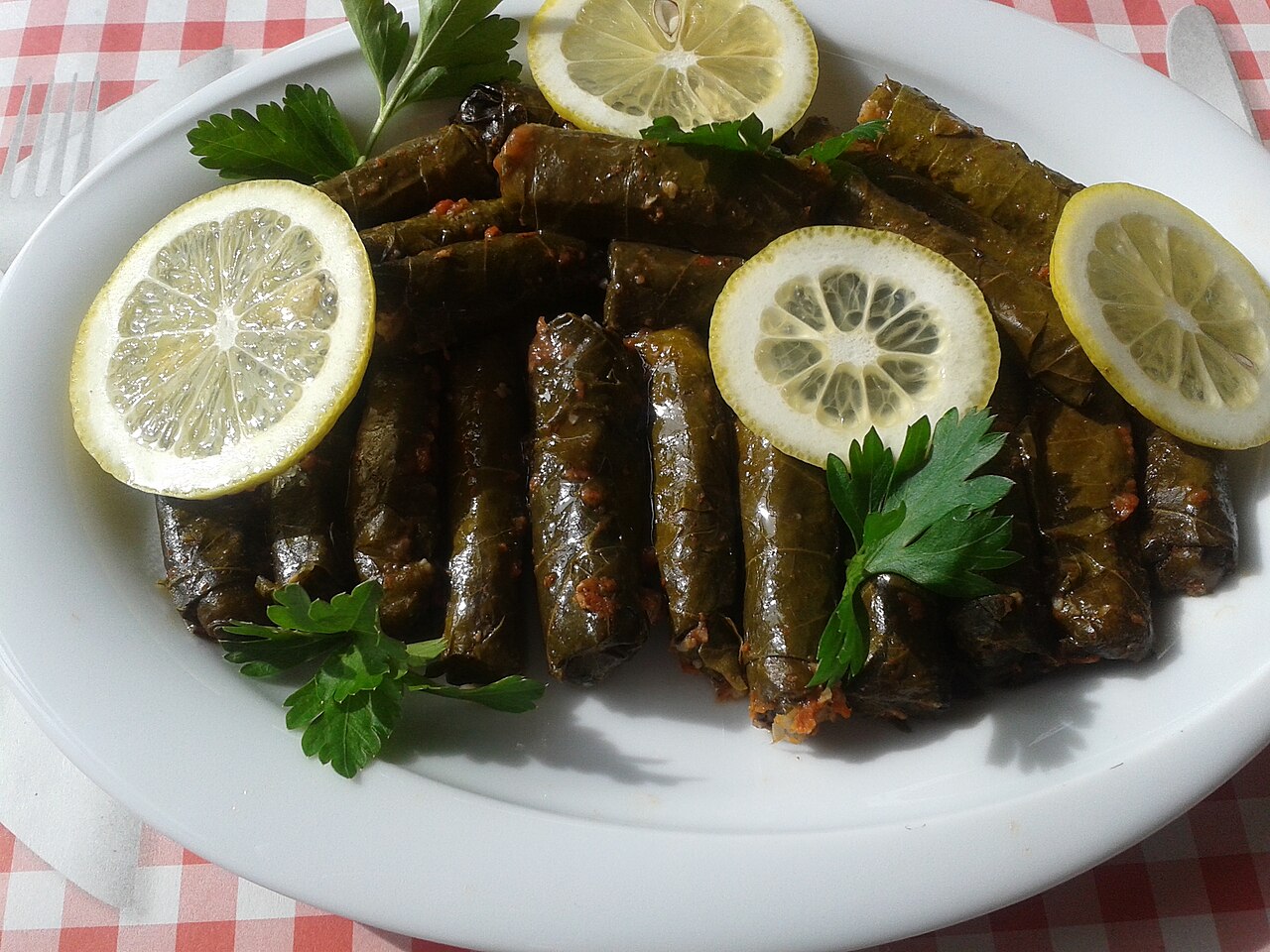
Yaprak Sarma (Stuffed Grape Leaves)
One serving has 377 kcal and 6 g protein, and at least a fifth of a woman's daily need of copper (100%), manganese (64%), vitamin K (58%), pantothenic acid (47%), folate (35%) and niacin (31%). Ready in 85 minutes.

- Preparation: 40 min
- Cooking: 45 min
- Makes: 1 serving (199 g)
- Difficulty: Hard
- Diets: Vegan, Gluten-free, Dairy-free
Ingredients
- 40 g Grape leaves, brined
- 40 g Rice, white, medium-grain
- 25 g Onions, raw
- 15 g Olive oil
- 15 g Tomatoes, raw
- 5 g Pine nuts
- 5 g Currants, dried
- 3 g Dill, fresh
- 0.5 g Mint, dried
- 8 g Lemon juice
- 40 g Water
- 2 g Sugar
- 0.5 g Salt
Method
- Rinse the brined grape leaves well under cold water to soften them and rinse away excess surface salt.
- Finely chop the onion and tomato, and cook the onion in half the olive oil over medium heat for 4-5 minutes until soft.
- Stir in the rice, tomato, pine nuts, currants, dill, dried mint, sugar and the salt, and cook for 2 minutes to lightly coat the rice; it stays raw at this stage and finishes cooking later.
- Lay a grape leaf shiny-side down, place a small spoonful of filling near the stem end, fold in the sides, and roll up tightly into a small log.
- Repeat with the remaining leaves and filling, and arrange the rolls snugly, seam-side down, in a single layer in a pot.
- Pour over the water, remaining oil and lemon juice, and weigh the rolls down with a small plate so they hold their shape.
- Cover and simmer gently for 40-45 minutes, until the rice is tender and the leaves are soft.
- Let the rolls cool to room temperature in the pot before serving, as yaprak sarma is traditionally eaten cool rather than hot.
Nutrition per serving
| Nutrient | Per serving | Share of a day's need |
|---|---|---|
| Energy | 377 kcal | 18% |
| Carbohydrates | 46.9 g | |
| Water | 123 mL | |
| Fiber | 5.8 g | 19% |
| Protein | 5.8 g | 12% |
| Tryptophan | 0.04 g | |
| Threonine | 0.13 g | |
| Isoleucine | 0.16 g | |
| Leucine | 0.29 g | |
| Lysine | 0.15 g | |
| Methionine | 0.08 g | |
| Cystine | 0.07 g | |
| Phenylalanine | 0.18 g | |
| Tyrosine | 0.13 g | |
| Valine | 0.21 g | |
| Histidine | 0.09 g | |
| Fat | 19.6 g | |
| Monounsaturated | 12 g | |
| Polyunsaturated | 3.8 g | |
| Docosahexaenoic Acid (DHA) | 0 g | |
| Eicosapentaenoic Acid (EPA) | 0 g | |
| Omega-6 | 3.3 g | |
| Saturated | 2.5 g | |
| Trans-Fats | 0 g | |
| Cholesterol | 0 mg | |
| Calcium | 147 mg | 15% |
| Copper | 0.9 mg | 100% |
| Iron | 4.1 mg | 23% |
| Magnesium | 43.6 mg | 14% |
| Manganese | 1.2 mg | 64% |
| Phosphorus | 105 mg | 15% |
| Potassium | 227 mg | 5% |
| Selenium | 6.6 µg | 12% |
| Sodium | 1,345 mg | |
| Zinc | 1.1 mg | 14% |
| Thiamin (vitamin B1) | 0.31 mg | 28% |
| Riboflavin (vitamin B2) | 0.21 mg | 19% |
| Niacin (vitamin B3) | 4.3 mg | 31% |
| Pantothenic acid (vitamin B5) | 2.3 mg | 47% |
| Pyridoxine (vitamin B6) | 0.2 mg | 15% |
| Folate (vitamin B9) | 142 µg | 35% |
| Cobalamin (vitamin B12) | 0 µg | 0% |
| Choline | 6.3 mg | 1% |
| Vitamin A | 126 µg | 18% |
| Vitamin C | 14.3 mg | 19% |
| Vitamin D (D2 + D3) | 0 IU | 0% |
| Vitamin E | 3.5 mg | 23% |
| Vitamin K | 52.1 µg | 58% |
Shares of a day's need are for a woman of 30, 165 cm, 60 kg, lightly active, by the US and Canadian Dietary Reference Intakes. SustainBite works out each person's own needs, by the standard where they live: the Nordic Nutrition Recommendations in Norway, the UK's, EFSA's in the EU.
Climate footprint
0.2 kg CO2e a serving: about average for breakfasts, sides, desserts and drinks on SustainBite. Source: ADEME, Agribalyse 3.2.
Plan weeks of recipes like this on SustainBite: meals that meet each person's vitamin and mineral needs, for a family too, with one grocery list. Free.