Recipes · Cameroonian · Main Courses
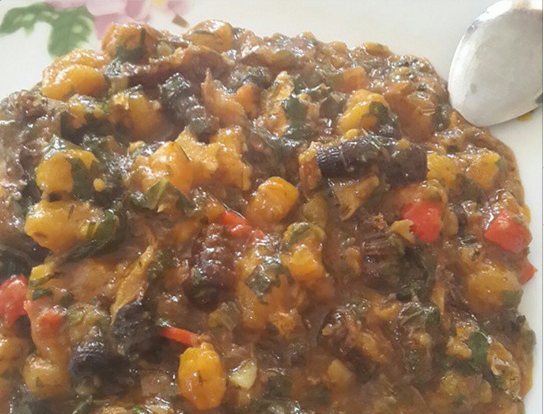
Ekwang (Cameroonian Cocoyam Rolls)
One serving has 910 kcal and 28 g protein, and at least a fifth of a woman's daily need of vitamin K (529%), vitamin C (196%), manganese (152%), pyridoxine (118%), copper (117%) and vitamin E (104%). Ready in 130 minutes.

- Preparation: 40 min
- Cooking: 90 min
- Makes: 1 serving (824 g)
- Difficulty: Hard
- Diets: Pescatarian, Gluten-free, Dairy-free
- Contains: fish, shellfish
Ingredients
- 350 g Taro, raw
- 120 g Kale, raw
- 40 g Palm oil
- 50 g Shrimp, raw
- 35 g Smoked fish
- 60 g Onions, raw
- 10 g Garlic, raw
- 8 g Chili peppers, red, raw
- 0.8 g Salt
- 150 g Water
Method
- Peel the cocoyams (taro) and grate them finely on the small holes of a box grater into a large bowl; the grated cocoyam should look like a thick, sticky paste.
- Wash the kale (standing in for the cocoyam leaves traditionally used) and lay several leaves flat, overlapping slightly, on a board.
- Spoon a line of grated cocoyam onto the leaves and roll them up tightly into firm parcels about 4 cm thick; repeat until all the cocoyam is used.
- Flake the smoked fish and finely chop the onion, garlic and chili. Pack the cocoyam rolls upright into a heavy pot and tuck the smoked fish, shrimp, onion, garlic and chili in among them.
- Pour the palm oil and water over the rolls, and season with the salt.
- Cover tightly and simmer over low-medium heat for 1.5 hours, checking occasionally and adding a splash more water if it looks dry, until the cocoyam rolls are tender all the way through and have soaked up the red palm-oil sauce.
- Spoon the rolls onto a plate with plenty of the palm-oil sauce, fish and shrimp spooned over the top, and serve hot.
Nutrition per serving
| Nutrient | Per serving | Share of a day's need |
|---|---|---|
| Energy | 910 kcal | 43% |
| Carbohydrates | 108 g | |
| Water | 635 mL | |
| Fiber | 20.6 g | 70% |
| Protein | 28.4 g | 59% |
| Tryptophan | 0.23 g | |
| Threonine | 0.79 g | |
| Isoleucine | 0.81 g | |
| Leucine | 1.4 g | |
| Lysine | 1.3 g | |
| Methionine | 0.36 g | |
| Cystine | 0.26 g | |
| Phenylalanine | 0.83 g | |
| Tyrosine | 0.61 g | |
| Valine | 0.95 g | |
| Histidine | 0.59 g | |
| Fat | 43.2 g | |
| Monounsaturated | 15.1 g | |
| Polyunsaturated | 5 g | |
| Docosahexaenoic Acid (DHA) | 0.07 g | |
| Eicosapentaenoic Acid (EPA) | 0.03 g | |
| Omega-6 | 4.3 g | |
| Saturated | 20.2 g | |
| Trans-Fats | 0 g | |
| Cholesterol | 92 mg | |
| Calcium | 531 mg | 53% |
| Copper | 1.1 mg | 117% |
| Iron | 4.7 mg | 26% |
| Magnesium | 193 mg | 62% |
| Manganese | 2.7 mg | 152% |
| Phosphorus | 549 mg | 78% |
| Potassium | 2,920 mg | 62% |
| Selenium | 10 µg | 18% |
| Sodium | 839 mg | |
| Zinc | 2.4 mg | 30% |
| Thiamin (vitamin B1) | 0.53 mg | 48% |
| Riboflavin (vitamin B2) | 0.57 mg | 52% |
| Niacin (vitamin B3) | 4.6 mg | 33% |
| Pantothenic acid (vitamin B5) | 1.7 mg | 34% |
| Pyridoxine (vitamin B6) | 1.5 mg | 118% |
| Folate (vitamin B9) | 167 µg | 42% |
| Cobalamin (vitamin B12) | 1.1 µg | 48% |
| Choline | 101 mg | 24% |
| Vitamin A | 327 µg | 47% |
| Vitamin C | 147 mg | 196% |
| Vitamin D (D2 + D3) | 179 IU | 30% |
| Vitamin E | 15.7 mg | 104% |
| Vitamin K | 476 µg | 529% |
Shares of a day's need are for a woman of 30, 165 cm, 60 kg, lightly active, by the US and Canadian Dietary Reference Intakes. SustainBite works out each person's own needs, by the standard where they live: the Nordic Nutrition Recommendations in Norway, the UK's, EFSA's in the EU.
Climate footprint
1.9 kg CO2e a serving: higher than most main dishes on SustainBite. Source: ADEME, Agribalyse 3.2.
Plan weeks of recipes like this on SustainBite: meals that meet each person's vitamin and mineral needs, for a family too, with one grocery list. Free.