Recipes · French · Desserts
Croquembouche
One serving has 251 kcal and 5 g protein, and at least a fifth of a woman's daily need of selenium (22%) and choline (21%). Ready in 60 minutes.
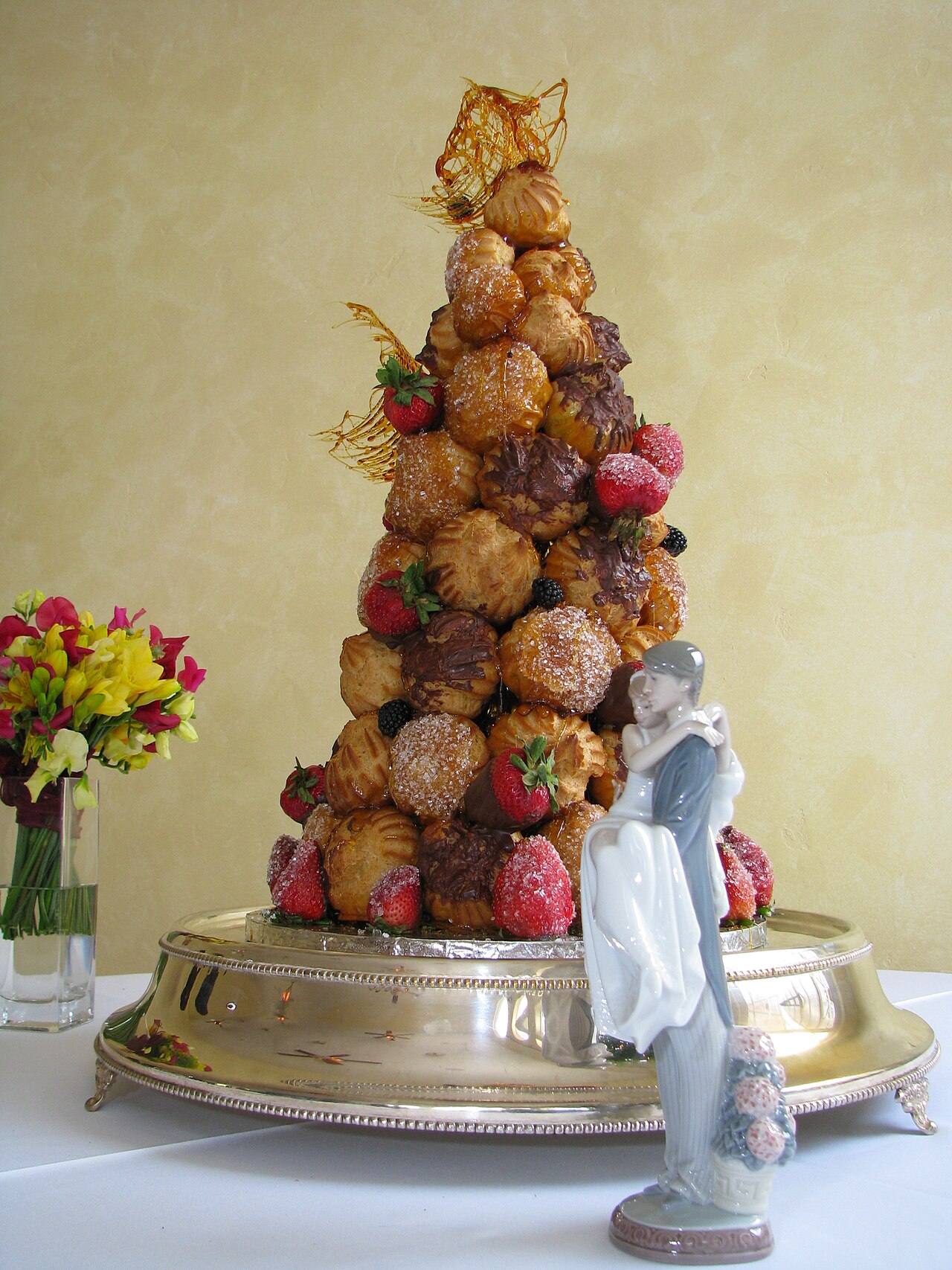

- Preparation: 30 min
- Cooking: 30 min
- Makes: 1 serving (110 g)
- Difficulty: Hard
- Diets: Vegetarian
- Contains: alcohol, dairy, egg, gluten
Ingredients
- 10 g Flour, all-purpose
- 8 g Butter, unsalted
- 15 g Eggs, whole, raw
- 15 g Water
- 0.2 g Salt
- 30 g Milk, whole
- 5 g Egg yolks, raw
- 23 g Sugar
- 3 g Cornstarch
- 0.3 g Vanilla extract
Method
- Makes 1 portion (about 3 small choux buns); a full party croquembouche needs roughly 40-50 times this. For the pastry cream, whisk the egg yolk with 8 g of the sugar and the cornstarch, then whisk in the warmed milk.
- Return the mixture to the pan and cook over medium heat, whisking constantly, until it thickens into a smooth custard; stir in the vanilla, then press cling film onto the surface and chill.
- For the choux, bring the water, butter and salt to a boil, tip in the flour all at once and beat hard over low heat for 1-2 minutes until it forms a smooth ball that pulls away from the pan.
- Cool the dough for a few minutes, then beat in the egg gradually until glossy; pipe or spoon small mounds onto a lined tray.
- Bake at 200 °C (400 °F) for 20-25 minutes until puffed, golden and dry-sounding when tapped; cool completely, then split and fill with the chilled pastry cream.
- For the caramel, heat the remaining 15 g sugar in a small pan without stirring until it turns a deep amber; work quickly, as it hardens fast once made.
- Dip the tops of the filled choux buns in the hot caramel and stack them into a small cone shape, letting the caramel glue them together as it sets.
Nutrition per serving
| Nutrient | Per serving | Share of a day's need |
|---|---|---|
| Energy | 251 kcal | 12% |
| Carbohydrates | 35.1 g | |
| Water | 58.4 mL | |
| Fiber | 0.3 g | 1% |
| Protein | 4.7 g | 10% |
| Tryptophan | 0.06 g | |
| Threonine | 0.19 g | |
| Isoleucine | 0.23 g | |
| Leucine | 0.4 g | |
| Lysine | 0.31 g | |
| Methionine | 0.12 g | |
| Cystine | 0.08 g | |
| Phenylalanine | 0.24 g | |
| Tyrosine | 0.19 g | |
| Valine | 0.28 g | |
| Histidine | 0.12 g | |
| Fat | 10.3 g | |
| Monounsaturated | 3.3 g | |
| Polyunsaturated | 0.84 g | |
| Docosahexaenoic Acid (DHA) | 0.01 g | |
| Eicosapentaenoic Acid (EPA) | 0 g | |
| Omega-6 | 0.63 g | |
| Saturated | 5.6 g | |
| Trans-Fats | 0.01 g | |
| Cholesterol | 130 mg | |
| Calcium | 53 mg | 5% |
| Copper | 0.04 mg | 4% |
| Iron | 0.9 mg | 5% |
| Magnesium | 7.7 mg | 2% |
| Manganese | 0.08 mg | 4% |
| Phosphorus | 87.5 mg | 13% |
| Potassium | 79.4 mg | 2% |
| Selenium | 12.2 µg | 22% |
| Sodium | 116 mg | |
| Zinc | 0.5 mg | 6% |
| Thiamin (vitamin B1) | 0.11 mg | 10% |
| Riboflavin (vitamin B2) | 0.2 mg | 18% |
| Niacin (vitamin B3) | 0.63 mg | 5% |
| Pantothenic acid (vitamin B5) | 0.54 mg | 11% |
| Pyridoxine (vitamin B6) | 0.06 mg | 5% |
| Folate (vitamin B9) | 34.4 µg | 9% |
| Cobalamin (vitamin B12) | 0.38 µg | 16% |
| Choline | 90.9 mg | 21% |
| Vitamin A | 112 µg | 16% |
| Vitamin C | 0 mg | 0% |
| Vitamin D (D2 + D3) | 38.5 IU | 6% |
| Vitamin E | 0.52 mg | 3% |
| Vitamin K | 0.76 µg | 1% |
Shares of a day's need are for a woman of 30, 165 cm, 60 kg, lightly active, by the US and Canadian Dietary Reference Intakes. SustainBite works out each person's own needs, by the standard where they live: the Nordic Nutrition Recommendations in Norway, the UK's, EFSA's in the EU.
Climate footprint
0.2 kg CO2e a serving: about average for breakfasts, sides, desserts and drinks on SustainBite. Source: ADEME, Agribalyse 3.2.
Plan weeks of recipes like this on SustainBite: meals that meet each person's vitamin and mineral needs, for a family too, with one grocery list. Free.