Recipes · Portuguese · Bread
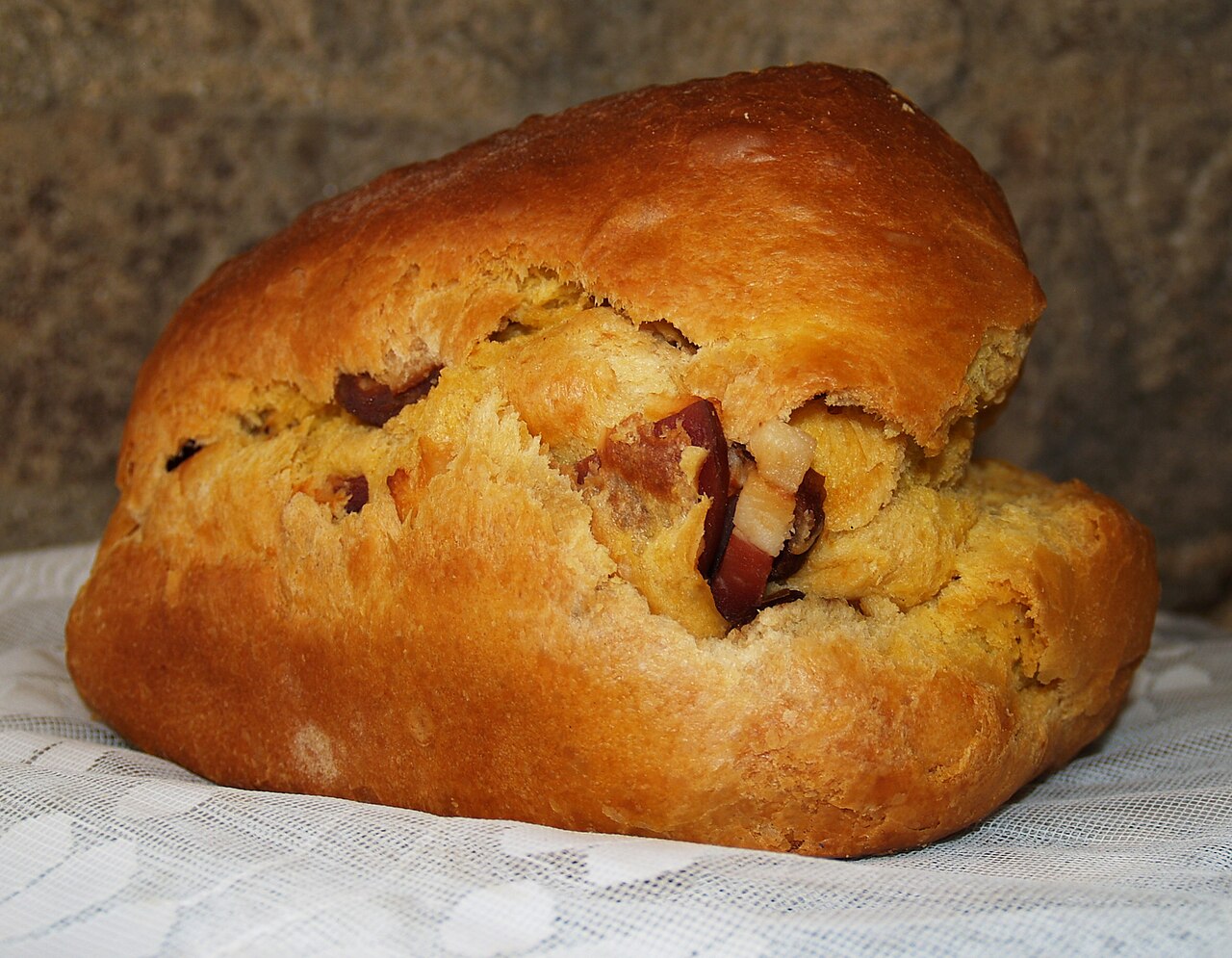
Folar de Chaves (Easter Bread with Meats)
One serving has 479 kcal and 22 g protein, and at least a fifth of a woman's daily need of selenium (85%), thiamin (84%), niacin (59%), riboflavin (53%), phosphorus (38%) and folate (37%). Ready in 180 minutes.

- Preparation: 120 min
- Cooking: 60 min
- Makes: 1 serving (178 g)
- Difficulty: Medium
- Contains: dairy, egg, gluten, pork
Ingredients
- 70 g Flour, all-purpose
- 1.5 g Yeast, fresh
- 5 g Sugar
- 6 g Olive oil
- 15 g Eggs, whole, raw
- 20 g Milk, whole
- 0.5 g Salt
- 40 g Pork loin, raw
- 12 g Kielbasa
- 8 g Ham, dry-cured
Method
- Makes 1 slice (about 1/8 of a loaf); multiply by 8 for a whole folar. The Chaves version is a savoury, meat-filled Easter bread, unlike the sweet folares found elsewhere in Portugal.
- Crumble the yeast into the warm milk with the sugar and let stand for 10 minutes until frothy.
- Mix the flour and salt in a bowl, make a well and pour in the yeast mixture, the egg and the olive oil; bring together and knead for 8-10 minutes to a smooth, elastic dough.
- Cover and leave to rise in a warm place for about 1.5 hours, until doubled in size.
- Meanwhile, cut the pork loin into small cubes and pan-fry until cooked through and lightly browned; thinly slice the kielbasa (standing in for Portuguese linguiça) and the dry-cured ham.
- Knock back the dough, roll out two-thirds of it and use to line a small loaf tin or line a round cake tin, leaving the edges overhanging.
- Scatter the cooked pork, kielbasa and ham over the dough, then roll out the remaining dough and lay it on top, sealing the edges over the filling.
- Cover and leave to prove for 30 minutes, then bake at 190 °C (375 °F) for 35-40 minutes until deep golden and hollow-sounding when tapped. Cool for 15 minutes before slicing.
Nutrition per serving
| Nutrient | Per serving | Share of a day's need |
|---|---|---|
| Energy | 479 kcal | 23% |
| Carbohydrates | 60.2 g | |
| Water | 77.4 mL | |
| Fiber | 2 g | 7% |
| Protein | 22 g | 46% |
| Tryptophan | 0.25 g | |
| Threonine | 0.85 g | |
| Isoleucine | 0.96 g | |
| Leucine | 1.7 g | |
| Lysine | 1.4 g | |
| Methionine | 0.53 g | |
| Cystine | 0.35 g | |
| Phenylalanine | 1 g | |
| Tyrosine | 0.77 g | |
| Valine | 1.1 g | |
| Histidine | 0.72 g | |
| Fat | 15.8 g | |
| Monounsaturated | 8.1 g | |
| Polyunsaturated | 2.3 g | |
| Docosahexaenoic Acid (DHA) | 0.01 g | |
| Eicosapentaenoic Acid (EPA) | 0 g | |
| Omega-6 | 2 g | |
| Saturated | 4.2 g | |
| Trans-Fats | 0.06 g | |
| Cholesterol | 97.5 mg | |
| Calcium | 48.5 mg | 5% |
| Copper | 0.16 mg | 18% |
| Iron | 4 mg | 22% |
| Magnesium | 33.9 mg | 11% |
| Manganese | 0.5 mg | 28% |
| Phosphorus | 263 mg | 38% |
| Potassium | 347 mg | 7% |
| Selenium | 46.6 µg | 85% |
| Sodium | 572 mg | |
| Zinc | 1.9 mg | 24% |
| Thiamin (vitamin B1) | 0.92 mg | 84% |
| Riboflavin (vitamin B2) | 0.58 mg | 53% |
| Niacin (vitamin B3) | 8.2 mg | 59% |
| Pantothenic acid (vitamin B5) | 1.1 mg | 22% |
| Pyridoxine (vitamin B6) | 0.41 mg | 32% |
| Folate (vitamin B9) | 148 µg | 37% |
| Cobalamin (vitamin B12) | 0.59 µg | 25% |
| Choline | 83.6 mg | 20% |
| Vitamin A | 34.6 µg | 5% |
| Vitamin C | 2.3 mg | 3% |
| Vitamin D (D2 + D3) | 36.3 IU | 6% |
| Vitamin E | 1.3 mg | 9% |
| Vitamin K | 4 µg | 4% |
Shares of a day's need are for a woman of 30, 165 cm, 60 kg, lightly active, by the US and Canadian Dietary Reference Intakes. SustainBite works out each person's own needs, by the standard where they live: the Nordic Nutrition Recommendations in Norway, the UK's, EFSA's in the EU.
Climate footprint
0.6 kg CO2e a serving: higher than most breakfasts, sides, desserts and drinks on SustainBite. Source: ADEME, Agribalyse 3.2.
Plan weeks of recipes like this on SustainBite: meals that meet each person's vitamin and mineral needs, for a family too, with one grocery list. Free.