Recipes · Swiss · Gingerbread
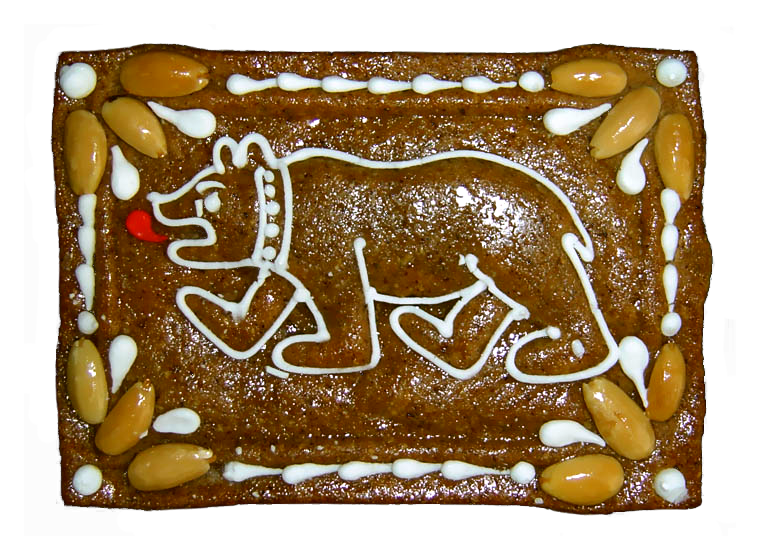
Berner Haselnusslebkuchen (Bernese Hazelnut Gingerbread)
One serving has 180 kcal and 3 g protein, and at least a fifth of a woman's daily need of manganese (56%) and copper (30%). Ready in 50 minutes.

- Preparation: 40 min
- Cooking: 10 min
- Makes: 1 serving (42.5 g)
- Difficulty: Medium
- Diets: Vegetarian, Dairy-free
- Contains: egg, gluten, nut
Ingredients
- 15 g Ground hazelnuts
- 12 g Sugar
- 4 g Egg white
- 3 g Candied orange and lemon peel
- 0.3 g Cinnamon
- 0.2 g Lemon zest
- 2 g Flour, all-purpose (for rolling)
- 5 g Icing sugar
- 1 g Water
Method
- Mix the ground hazelnuts with the sugar, the finely chopped candied peel, the cinnamon and the lemon zest.
- Add the lightly beaten egg white a little at a time and knead to a firm, slightly sticky dough. Cover and leave it to rest for 30 minutes.
- Heat the oven to 200 °C. On a lightly floured surface, or between two sheets of baking paper, roll the dough out about 1 cm thick and cut it into rectangles, or into bears with a cutter.
- Lay them on a tray lined with baking paper and bake for 8-10 minutes, until lightly browned at the edges but still soft in the middle.
- Stir the icing sugar with the water to a thin glaze and brush it over the lebkuchen while they are still warm.
- Leave them to cool, then keep them in a tin for a day or two, where they soften and the flavour deepens.
Nutrition per serving
| Nutrient | Per serving | Share of a day's need |
|---|---|---|
| Energy | 180 kcal | 8% |
| Carbohydrates | 23.8 g | |
| Water | 6.3 mL | |
| Fiber | 1.7 g | 6% |
| Protein | 2.9 g | 6% |
| Tryptophan | 0.04 g | |
| Threonine | 0.1 g | |
| Isoleucine | 0.12 g | |
| Leucine | 0.22 g | |
| Lysine | 0.1 g | |
| Methionine | 0.05 g | |
| Cystine | 0.06 g | |
| Phenylalanine | 0.14 g | |
| Tyrosine | 0.08 g | |
| Valine | 0.15 g | |
| Histidine | 0.08 g | |
| Fat | 9.2 g | |
| Monounsaturated | 6.8 g | |
| Polyunsaturated | 1.2 g | |
| Docosahexaenoic Acid (DHA) | 0 g | |
| Eicosapentaenoic Acid (EPA) | 0 g | |
| Omega-6 | 1.2 g | |
| Saturated | 0.67 g | |
| Trans-Fats | 0 g | |
| Cholesterol | 0 mg | |
| Calcium | 21.7 mg | 2% |
| Copper | 0.27 mg | 30% |
| Iron | 0.84 mg | 5% |
| Magnesium | 25.7 mg | 8% |
| Manganese | 1 mg | 56% |
| Phosphorus | 46.6 mg | 7% |
| Potassium | 114 mg | 2% |
| Selenium | 2 µg | 4% |
| Sodium | 9.9 mg | |
| Zinc | 0.39 mg | 5% |
| Thiamin (vitamin B1) | 0.11 mg | 10% |
| Riboflavin (vitamin B2) | 0.05 mg | 5% |
| Niacin (vitamin B3) | 0.4 mg | 3% |
| Pantothenic acid (vitamin B5) | 0.16 mg | 3% |
| Pyridoxine (vitamin B6) | 0.09 mg | 7% |
| Folate (vitamin B9) | 20.8 µg | 5% |
| Cobalamin (vitamin B12) | 0 µg | 0% |
| Choline | 7 mg | 2% |
| Vitamin A | 0.23 µg | 0% |
| Vitamin C | 1.2 mg | 2% |
| Vitamin D (D2 + D3) | 0 IU | 0% |
| Vitamin E | 2.3 mg | 15% |
| Vitamin K | 2.2 µg | 2% |
Shares of a day's need are for a woman of 30, 165 cm, 60 kg, lightly active, by the US and Canadian Dietary Reference Intakes. SustainBite works out each person's own needs, by the standard where they live: the Nordic Nutrition Recommendations in Norway, the UK's, EFSA's in the EU.
Climate footprint
0.1 kg CO2e a serving: lower than most breakfasts, sides, desserts and drinks on SustainBite. Source: ADEME, Agribalyse 3.2.
Plan weeks of recipes like this on SustainBite: meals that meet each person's vitamin and mineral needs, for a family too, with one grocery list. Free.