Recipes · Croatian · Desserts
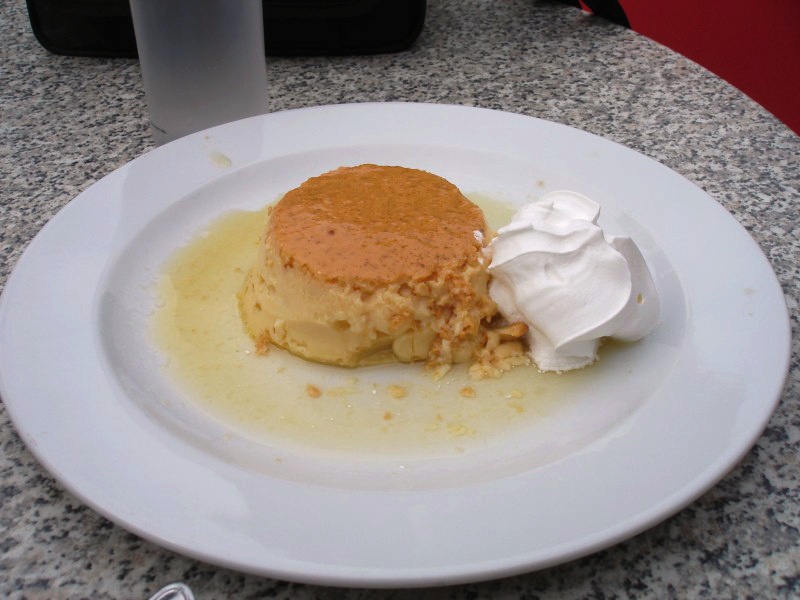
Rožata (Dubrovnik Caramel Custard)
One serving has 268 kcal and 9 g protein, and at least a fifth of a woman's daily need of cobalamin (38%), riboflavin (36%), choline (32%), selenium (31%), phosphorus (26%) and pantothenic acid (22%). Ready in 450 minutes.

- Preparation: 380 min
- Cooking: 70 min
- Makes: 1 serving (202 g)
- Difficulty: Medium
- Diets: Vegetarian, Gluten-free
- Contains: alcohol, dairy, egg
Ingredients
- 32 g Sugar
- 125 g Milk, whole
- 40 g Eggs, whole, raw
- 0.5 g Lemon zest
- 0.5 g Vanilla extract
- 4 g Rose liqueur (rozalin) or rum
Method
- Warm the milk with the lemon zest and the vanilla until it steams, then take it off the heat and leave it for 15 minutes to take their flavour.
- Melt about a third of the sugar in a dry pan over medium heat for 5-7 minutes, swirling the pan, until it turns a deep amber caramel. Pour it at once into a ring mould or small moulds and tilt them so it coats the bottom and a little of the sides; it sets hard quickly.
- Beat the eggs with the rest of the sugar only until mixed, without whipping them to a foam: bubbles leave holes in the custard. Stir in the warm milk and the rozalin, then pour it through a sieve into the mould.
- Stand the mould in a roasting tin and pour hot water into the tin to come halfway up. Bake at 150 °C for 50-60 minutes (small moulds for 30-35 minutes), until set but still trembling a little in the middle.
- Leave it to cool, then chill it in the fridge for at least 6 hours, better overnight, so the caramel melts into a sauce.
- Run a thin knife round the edge, put a deep plate on top and turn it over in one go. Serve cold, in slices, with the caramel sauce poured over.
- Rozalin, the rose liqueur of Dubrovnik, gives rožata its scent; where there is none, a little rum or rose water is used.
Nutrition per serving
| Nutrient | Per serving | Share of a day's need |
|---|---|---|
| Energy | 268 kcal | 13% |
| Carbohydrates | 38.4 g | |
| Water | 144 mL | |
| Fiber | 0.05 g | 0% |
| Protein | 9 g | 19% |
| Tryptophan | 0.12 g | |
| Threonine | 0.39 g | |
| Isoleucine | 0.47 g | |
| Leucine | 0.81 g | |
| Lysine | 0.69 g | |
| Methionine | 0.26 g | |
| Cystine | 0.13 g | |
| Phenylalanine | 0.48 g | |
| Tyrosine | 0.4 g | |
| Valine | 0.6 g | |
| Histidine | 0.24 g | |
| Fat | 7.9 g | |
| Monounsaturated | 2.5 g | |
| Polyunsaturated | 1 g | |
| Docosahexaenoic Acid (DHA) | 0.02 g | |
| Eicosapentaenoic Acid (EPA) | 0 g | |
| Omega-6 | 0.77 g | |
| Saturated | 3.6 g | |
| Trans-Fats | 0.02 g | |
| Cholesterol | 161 mg | |
| Calcium | 165 mg | 16% |
| Copper | 0.06 mg | 7% |
| Iron | 0.76 mg | 4% |
| Magnesium | 17.4 mg | 6% |
| Manganese | 0.02 mg | 1% |
| Phosphorus | 184 mg | 26% |
| Potassium | 222 mg | 5% |
| Selenium | 17.1 µg | 31% |
| Sodium | 111 mg | |
| Zinc | 0.99 mg | 12% |
| Thiamin (vitamin B1) | 0.07 mg | 6% |
| Riboflavin (vitamin B2) | 0.4 mg | 36% |
| Niacin (vitamin B3) | 0.15 mg | 1% |
| Pantothenic acid (vitamin B5) | 1.1 mg | 22% |
| Pyridoxine (vitamin B6) | 0.11 mg | 8% |
| Folate (vitamin B9) | 25.1 µg | 6% |
| Cobalamin (vitamin B12) | 0.92 µg | 38% |
| Choline | 135 mg | 32% |
| Vitamin A | 122 µg | 17% |
| Vitamin C | 0.65 mg | 1% |
| Vitamin D (D2 + D3) | 96.5 IU | 16% |
| Vitamin E | 0.51 mg | 3% |
| Vitamin K | 0.5 µg | 1% |
Shares of a day's need are for a woman of 30, 165 cm, 60 kg, lightly active, by the US and Canadian Dietary Reference Intakes. SustainBite works out each person's own needs, by the standard where they live: the Nordic Nutrition Recommendations in Norway, the UK's, EFSA's in the EU.
Climate footprint
0.3 kg CO2e a serving: about average for breakfasts, sides, desserts and drinks on SustainBite. Source: ADEME, Agribalyse 3.2.
Plan weeks of recipes like this on SustainBite: meals that meet each person's vitamin and mineral needs, for a family too, with one grocery list. Free.