Recipes · Maltese · Bakery
Pastizzi (Maltese Ricotta Pastries)
One serving has 411 kcal and 12 g protein, and at least a fifth of a woman's daily need of selenium (47%), riboflavin (44%), thiamin (38%), vitamin A (33%), niacin (28%) and cobalamin (25%). Ready in 700 minutes.
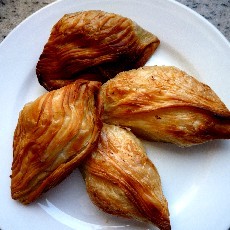

- Preparation: 670 min
- Cooking: 30 min
- Makes: 1 serving (164 g)
- Difficulty: Hard
- Diets: Vegetarian
- Contains: dairy, egg, gluten
Ingredients
- 50 g Flour, bread (strong)
- 28 g Water
- 0.3 g Salt
- 18 g Margarine, softened
- 60 g Ricotta (irkotta)
- 8 g Eggs, whole, raw
- 0.1 g Black pepper
Method
- Mix the flour with most of the salt and the water and knead for 10-15 minutes into a smooth, very elastic dough. Rub it with a little of the margarine, cover and leave to rest for 1 hour.
- On a lightly greased table, roll the dough out thin, then stretch it by hand from the middle outwards until it is almost thin enough to see through.
- Spread the whole sheet with the soft margarine. Starting from one edge, roll it up tightly into a long log about 4 cm thick, stretching the sheet gently as you go so the layers stay thin. Wrap the log and chill it overnight, for at least 8 hours, so the fat sets between the layers.
- For the filling, mash the ricotta with the egg, the rest of the salt and the pepper until smooth.
- Cut the log into slices about 2.5 cm thick. Hold a slice cut side up and press the middle down with your thumbs, pushing outwards, so it opens into a cup with the layers fanning out round its rim.
- Put a spoonful of the ricotta in the cup and pull the edges up over it, pinching them together into a pointed oval, with the layers on the outside. Set the pastizzi on a baking tray.
- Bake at 210 °C for 25-30 minutes, until golden and the layers have opened into crisp, flaky leaves. Eat them warm, on the day they are baked. The other classic filling is mashed peas with onion (pastizzi tal-piżelli).
Nutrition per serving
| Nutrient | Per serving | Share of a day's need |
|---|---|---|
| Energy | 411 kcal | 19% |
| Carbohydrates | 40.9 g | |
| Water | 87.9 mL | |
| Fiber | 1.2 g | 4% |
| Protein | 11.6 g | 24% |
| Tryptophan | 0.08 g | |
| Threonine | 0.2 g | |
| Isoleucine | 0.28 g | |
| Leucine | 0.5 g | |
| Lysine | 0.19 g | |
| Methionine | 0.14 g | |
| Cystine | 0.16 g | |
| Phenylalanine | 0.35 g | |
| Tyrosine | 0.2 g | |
| Valine | 0.32 g | |
| Histidine | 0.15 g | |
| Fat | 22.2 g | |
| Monounsaturated | 9 g | |
| Polyunsaturated | 5.2 g | |
| Docosahexaenoic Acid (DHA) | 0.01 g | |
| Eicosapentaenoic Acid (EPA) | 0 g | |
| Omega-6 | 4.7 g | |
| Saturated | 7 g | |
| Trans-Fats | 2.9 g | |
| Cholesterol | 59.2 mg | |
| Calcium | 137 mg | 14% |
| Copper | 0.11 mg | 12% |
| Iron | 2.4 mg | 14% |
| Magnesium | 26.4 mg | 9% |
| Manganese | 0.42 mg | 23% |
| Phosphorus | 158 mg | 23% |
| Potassium | 197 mg | 4% |
| Selenium | 25.9 µg | 47% |
| Sodium | 331 mg | |
| Zinc | 0.85 mg | 11% |
| Thiamin (vitamin B1) | 0.42 mg | 38% |
| Riboflavin (vitamin B2) | 0.48 mg | 44% |
| Niacin (vitamin B3) | 3.9 mg | 28% |
| Pantothenic acid (vitamin B5) | 0.62 mg | 12% |
| Pyridoxine (vitamin B6) | 0.09 mg | 7% |
| Folate (vitamin B9) | 97.9 µg | 24% |
| Cobalamin (vitamin B12) | 0.6 µg | 25% |
| Choline | 41.5 mg | 10% |
| Vitamin A | 232 µg | 33% |
| Vitamin C | 0.04 mg | 0% |
| Vitamin D (D2 + D3) | 12.6 IU | 2% |
| Vitamin E | 2 mg | 13% |
| Vitamin K | 17.7 µg | 20% |
Shares of a day's need are for a woman of 30, 165 cm, 60 kg, lightly active, by the US and Canadian Dietary Reference Intakes. SustainBite works out each person's own needs, by the standard where they live: the Nordic Nutrition Recommendations in Norway, the UK's, EFSA's in the EU.
Plan weeks of recipes like this on SustainBite: meals that meet each person's vitamin and mineral needs, for a family too, with one grocery list. Free.