Recipes · Swedish · Main Courses
Dillkött (Swedish Veal in Sweet-Sour Dill Sauce)
One serving has 638 kcal and 42 g protein, and at least a fifth of a woman's daily need of niacin (119%), pyridoxine (112%), cobalamin (103%), zinc (81%), phosphorus (76%) and vitamin C (70%). Ready in 120 minutes.
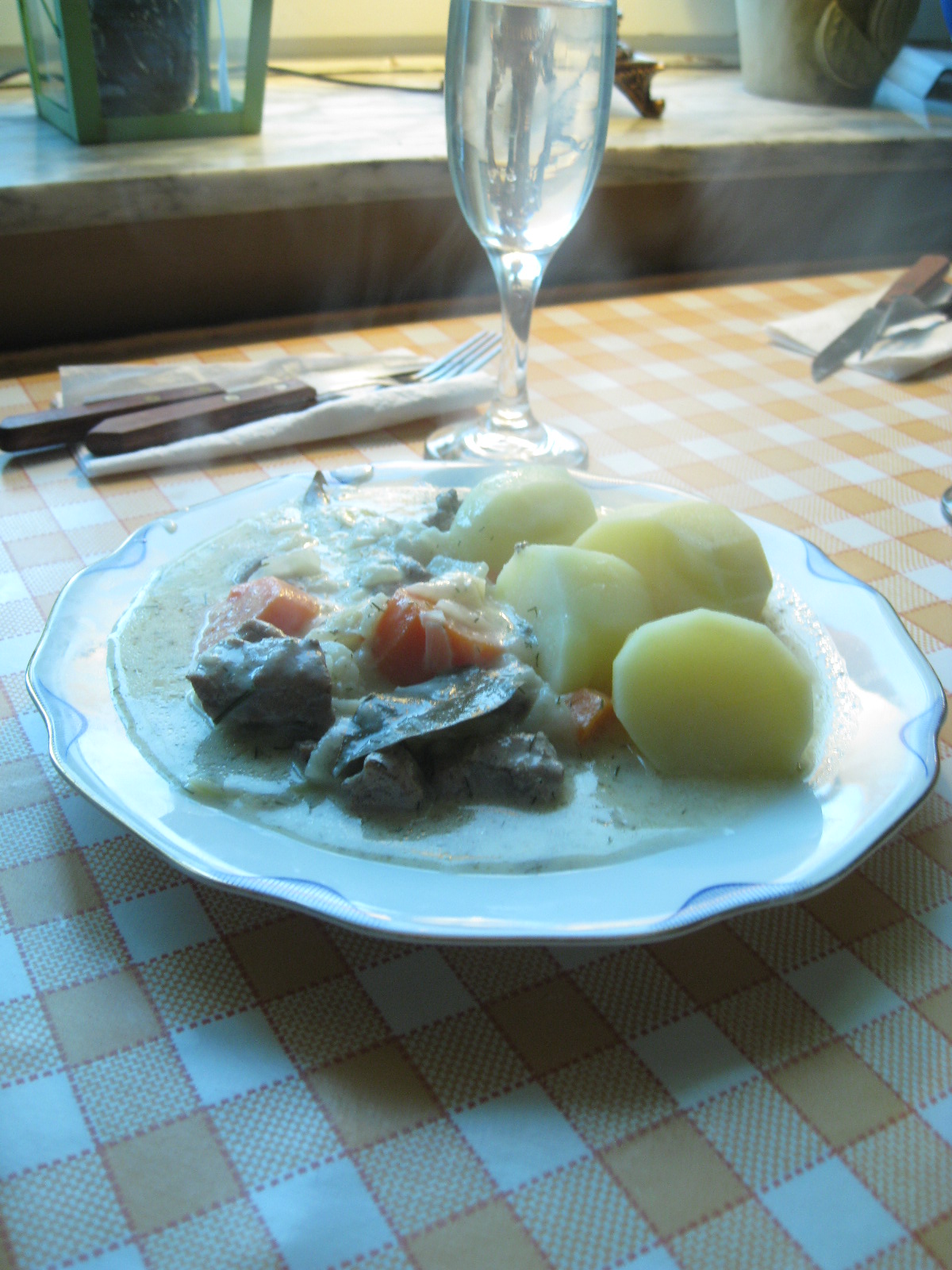

- Preparation: 15 min
- Cooking: 105 min
- Makes: 1 serving (1,013 g)
- Difficulty: Medium
- Diets: High protein
- Contains: beef, dairy, gluten
Ingredients
- 180 g Veal shoulder or breast, raw, for stewing
- 500 g Water
- 1 g Salt
- 30 g Carrots, raw
- 30 g Onions, raw
- 0.2 g Bay leaf
- 0.3 g White peppercorns
- 0.3 g Allspice, whole
- 10 g Dill, fresh, with stalks
- 200 g Potatoes, raw
- 8 g Butter, unsalted
- 8 g Flour, all-purpose
- 25 g Cream, heavy
- 15 g White vinegar, 5% (or less than half as much 12% ättika)
- 5 g Sugar
Method
- Put the veal in a pot, cover it with the cold water and bring it to the boil. Skim off the grey foam that rises.
- Add most of the salt, the carrot and onion in large pieces, the bay leaf, white peppercorns, allspice and the dill stalks; keep the dill fronds for the sauce. Cover and simmer gently for about 1 hour 30 minutes, until the meat is tender.
- Towards the end, peel the potatoes and boil them in water with the rest of the salt for 20 minutes, until tender.
- Lift out the meat, cut it into pieces and keep it warm. Strain the broth.
- Melt the butter in a pan, stir in the flour, then whisk in about 150 ml of the broth a little at a time and simmer for 5 minutes. Stir in the cream.
- Season the sauce with the vinegar and sugar until it tastes clearly sweet and sour, then stir in the dill fronds, chopped, and put the meat back to heat through; don't let it boil once the dill is in.
- Serve with the boiled potatoes.
Nutrition per serving
| Nutrient | Per serving | Share of a day's need |
|---|---|---|
| Energy | 638 kcal | 30% |
| Carbohydrates | 53.8 g | |
| Water | 882 mL | |
| Fiber | 6.2 g | 21% |
| Protein | 41.5 g | 87% |
| Tryptophan | 0.43 g | |
| Threonine | 1.8 g | |
| Isoleucine | 2 g | |
| Leucine | 3.1 g | |
| Lysine | 3.2 g | |
| Methionine | 0.92 g | |
| Cystine | 0.49 g | |
| Phenylalanine | 1.7 g | |
| Tyrosine | 1.3 g | |
| Valine | 2.3 g | |
| Histidine | 1.4 g | |
| Fat | 28.2 g | |
| Monounsaturated | 8.9 g | |
| Polyunsaturated | 1.7 g | |
| Docosahexaenoic Acid (DHA) | 0 g | |
| Eicosapentaenoic Acid (EPA) | 0 g | |
| Omega-6 | 1.3 g | |
| Saturated | 14.9 g | |
| Trans-Fats | 0.31 g | |
| Cholesterol | 193 mg | |
| Calcium | 129 mg | 13% |
| Copper | 0.53 mg | 59% |
| Iron | 4.5 mg | 25% |
| Magnesium | 111 mg | 36% |
| Manganese | 0.67 mg | 37% |
| Phosphorus | 532 mg | 76% |
| Potassium | 1,670 mg | 36% |
| Selenium | 19.8 µg | 36% |
| Sodium | 604 mg | |
| Zinc | 6.5 mg | 81% |
| Thiamin (vitamin B1) | 0.41 mg | 37% |
| Riboflavin (vitamin B2) | 0.7 mg | 64% |
| Niacin (vitamin B3) | 16.6 mg | 119% |
| Pantothenic acid (vitamin B5) | 3.3 mg | 65% |
| Pyridoxine (vitamin B6) | 1.4 mg | 112% |
| Folate (vitamin B9) | 96.2 µg | 24% |
| Cobalamin (vitamin B12) | 2.5 µg | 103% |
| Choline | 34.4 mg | 8% |
| Vitamin A | 447 µg | 64% |
| Vitamin C | 52.3 mg | 70% |
| Vitamin D (D2 + D3) | 15.8 IU | 3% |
| Vitamin E | 1.1 mg | 8% |
| Vitamin K | 9.5 µg | 11% |
Shares of a day's need are for a woman of 30, 165 cm, 60 kg, lightly active, by the US and Canadian Dietary Reference Intakes. SustainBite works out each person's own needs, by the standard where they live: the Nordic Nutrition Recommendations in Norway, the UK's, EFSA's in the EU.
Climate footprint
3.7 kg CO2e a serving: higher than most main dishes on SustainBite. Source: ADEME, Agribalyse 3.2.
Plan weeks of recipes like this on SustainBite: meals that meet each person's vitamin and mineral needs, for a family too, with one grocery list. Free.