Recipes · Swedish · Main Courses
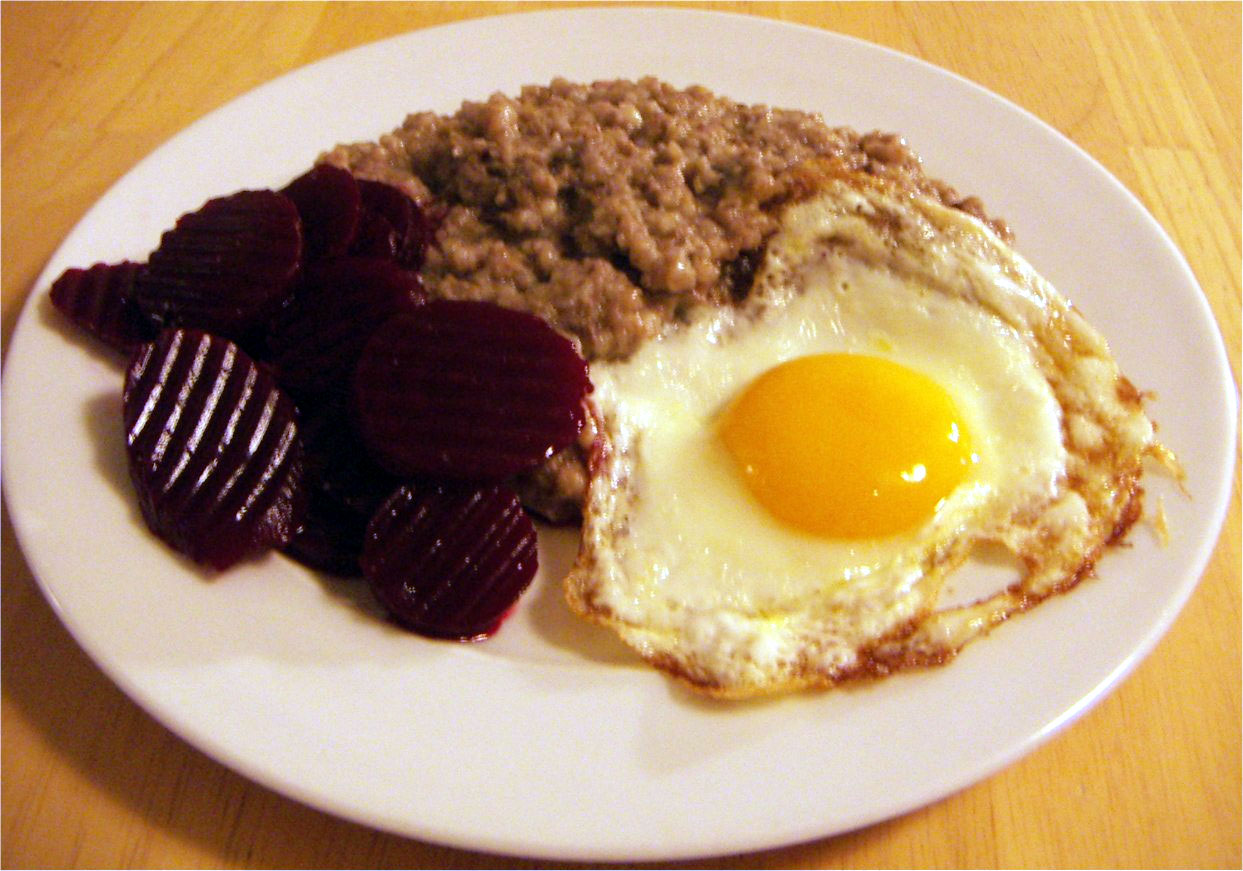
Pölsa (Swedish Hash of Heart, Pork and Barley)
One serving has 630 kcal and 34 g protein, and at least a fifth of a woman's daily need of cobalamin (284%), riboflavin (102%), selenium (95%), pyridoxine (91%), copper (84%) and niacin (75%). Ready in 170 minutes.

- Preparation: 20 min
- Cooking: 150 min
- Makes: 1 serving (735 g)
- Difficulty: Medium
- Diets: High protein
- Contains: beef, dairy, egg, gluten, meat, pork
Ingredients
- 70 g Beef heart, raw
- 50 g Pork shoulder, raw
- 250 g Water
- 0.1 g Bay leaves
- 0.4 g Allspice, whole
- 20 g Barley, pearl
- 40 g Onions, raw
- 13 g Butter, unsalted
- 0.2 g White pepper
- 0.2 g Marjoram, dried
- 1 g Salt
- 200 g Potatoes, raw
- 50 g Eggs, whole, raw
- 40 g Beets, pickled
Method
- Put the beef heart and pork in a pot with the water, bay leaf and allspice, bring to the boil and skim. Cover and simmer gently for 1 hour 30 minutes to 2 hours, until tender.
- Lift out the meat and keep the stock. Rinse the barley and simmer it in some of the stock for 25-30 minutes, until tender.
- Trim off any gristle and grind the meat coarsely, or chop it very finely.
- Soften the chopped onion in a third of the butter for 5 minutes, then add the meat, barley, white pepper, marjoram and salt, with enough stock to make a thick, loose hash. Simmer for 10-15 minutes, stirring now and then.
- Meanwhile boil the potatoes for 15-20 minutes, let them cool a little, slice them and fry them in most of the remaining butter for 8-10 minutes, until golden.
- Fry the egg in the last of the butter.
- Serve the pölsa hot with the fried potatoes, the fried egg and pickled beetroot.
Nutrition per serving
| Nutrient | Per serving | Share of a day's need |
|---|---|---|
| Energy | 630 kcal | 30% |
| Carbohydrates | 61.9 g | |
| Water | 605 mL | |
| Fiber | 8.6 g | 29% |
| Protein | 34.3 g | 71% |
| Tryptophan | 0.27 g | |
| Threonine | 0.89 g | |
| Isoleucine | 0.95 g | |
| Leucine | 1.6 g | |
| Lysine | 1.6 g | |
| Methionine | 0.52 g | |
| Cystine | 0.34 g | |
| Phenylalanine | 0.98 g | |
| Tyrosine | 0.71 g | |
| Valine | 1.2 g | |
| Histidine | 0.61 g | |
| Fat | 27.6 g | |
| Monounsaturated | 9.7 g | |
| Polyunsaturated | 2.9 g | |
| Docosahexaenoic Acid (DHA) | 0.03 g | |
| Eicosapentaenoic Acid (EPA) | 0 g | |
| Omega-6 | 2.3 g | |
| Saturated | 12.3 g | |
| Trans-Fats | 0.14 g | |
| Cholesterol | 336 mg | |
| Calcium | 103 mg | 10% |
| Copper | 0.76 mg | 84% |
| Iron | 7.1 mg | 39% |
| Magnesium | 106 mg | 34% |
| Manganese | 0.79 mg | 44% |
| Phosphorus | 520 mg | 74% |
| Potassium | 1,442 mg | 31% |
| Selenium | 52.5 µg | 95% |
| Sodium | 647 mg | |
| Zinc | 4.4 mg | 56% |
| Thiamin (vitamin B1) | 0.79 mg | 72% |
| Riboflavin (vitamin B2) | 1.1 mg | 102% |
| Niacin (vitamin B3) | 10.4 mg | 75% |
| Pantothenic acid (vitamin B5) | 3.1 mg | 63% |
| Pyridoxine (vitamin B6) | 1.2 mg | 91% |
| Folate (vitamin B9) | 82.4 µg | 21% |
| Cobalamin (vitamin B12) | 6.8 µg | 284% |
| Choline | 220 mg | 52% |
| Vitamin A | 172 µg | 25% |
| Vitamin C | 45.4 mg | 61% |
| Vitamin D (D2 + D3) | 76 IU | 13% |
| Vitamin E | 1.1 mg | 8% |
| Vitamin K | 7 µg | 8% |
Shares of a day's need are for a woman of 30, 165 cm, 60 kg, lightly active, by the US and Canadian Dietary Reference Intakes. SustainBite works out each person's own needs, by the standard where they live: the Nordic Nutrition Recommendations in Norway, the UK's, EFSA's in the EU.
Climate footprint
2.4 kg CO2e a serving: higher than most main dishes on SustainBite. Source: ADEME, Agribalyse 3.2.
Plan weeks of recipes like this on SustainBite: meals that meet each person's vitamin and mineral needs, for a family too, with one grocery list. Free.