Recipes · British · Pies
Maids of Honour (Richmond Curd Tarts)
One serving has 441 kcal and 10 g protein, and at least a fifth of a woman's daily need of selenium (34%), riboflavin (27%) and phosphorus (21%). Ready in 55 minutes.
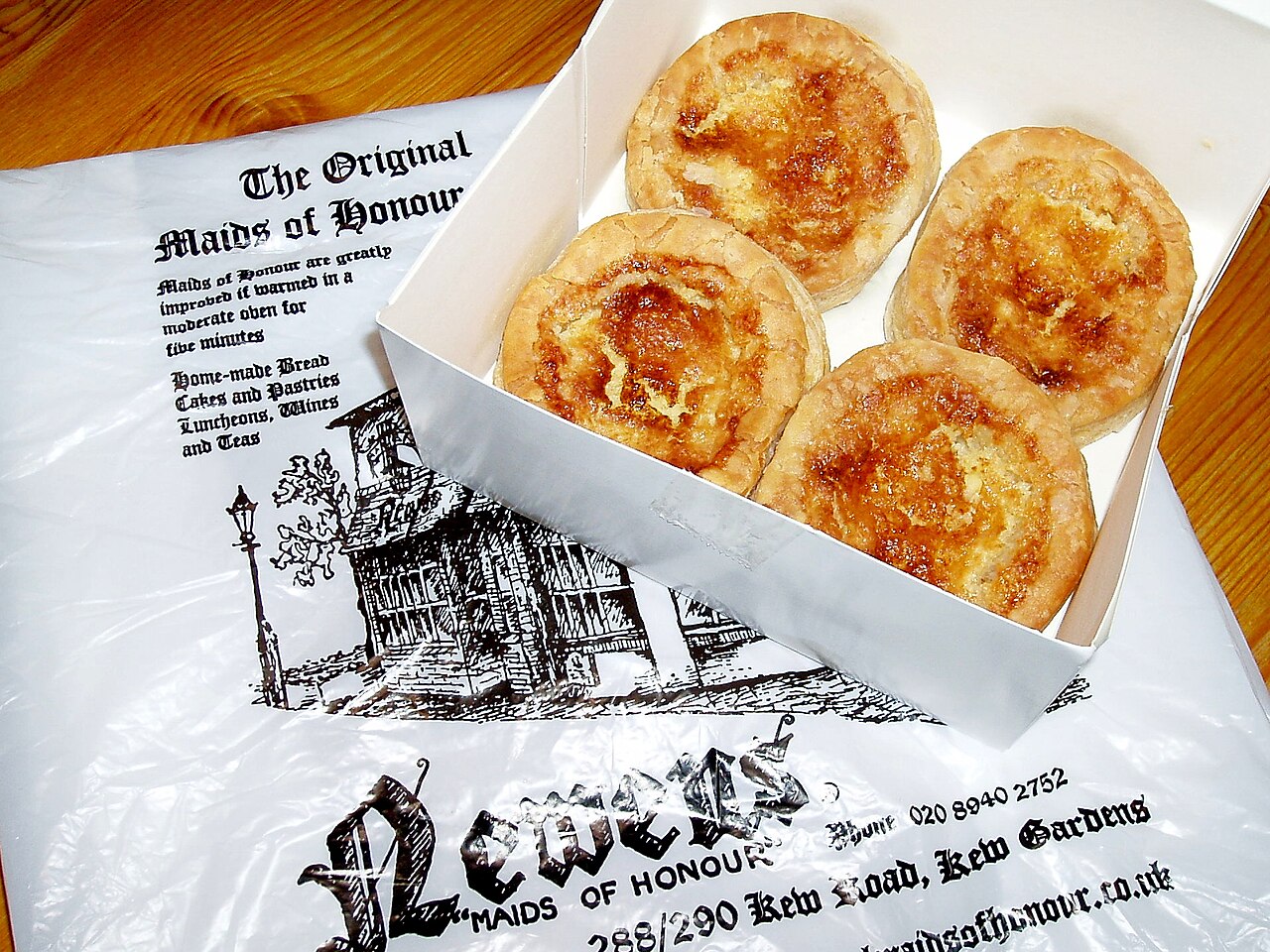

- Preparation: 30 min
- Cooking: 25 min
- Makes: 1 serving (121 g)
- Difficulty: Medium
- Diets: Vegetarian
- Contains: dairy, egg, gluten, nut
Ingredients
- 42 g Puff pastry
- 33 g Curd cheese (or cottage cheese)
- 9.2 g Unsalted butter, softened
- 12 g Caster sugar
- 17 g Eggs
- 6.7 g Ground almonds
- 0.7 g Lemon zest
- 0.1 g Nutmeg, freshly grated
Method
- Makes 12 tarts, two to a serving; the amounts are for one serving of two tarts, so multiply every ingredient by 6 for the whole batch. Heat the oven to 200 °C (400 °F) and grease a 12-hole bun or shallow muffin tin with a little of the butter.
- Press the curd cheese through a sieve with the back of a spoon so it is perfectly smooth; if you use cottage cheese, squeeze it dry in a clean cloth first.
- Roll the puff pastry out to about 3 mm thick, cut 12 rounds with a 9 cm cutter and press them into the tin. Chill while you make the filling.
- Beat the rest of the butter with the sugar until pale and creamy, then beat in the eggs one at a time. Stir in the sieved curd cheese, the ground almonds, the lemon zest and the nutmeg to make a thick, smooth batter.
- Spoon the filling into the pastry cases, filling each about two-thirds full: it puffs up as it bakes.
- Bake for 20-25 minutes, until the pastry is crisp and golden and the filling has risen, browned on top and feels just firm when pressed. The filling sinks a little as it cools, as it should.
- Leave in the tin for 5 minutes, then lift onto a rack. Eat warm or cold, on the day they are baked.
Nutrition per serving
| Nutrient | Per serving | Share of a day's need |
|---|---|---|
| Energy | 441 kcal | 21% |
| Carbohydrates | 33.6 g | |
| Water | 45.2 mL | |
| Fiber | 1.4 g | 5% |
| Protein | 10.4 g | 22% |
| Tryptophan | 0.13 g | |
| Threonine | 0.39 g | |
| Isoleucine | 0.47 g | |
| Leucine | 0.87 g | |
| Lysine | 0.57 g | |
| Methionine | 0.22 g | |
| Cystine | 0.16 g | |
| Phenylalanine | 0.54 g | |
| Tyrosine | 0.41 g | |
| Valine | 0.58 g | |
| Histidine | 0.27 g | |
| Fat | 30.1 g | |
| Monounsaturated | 14.3 g | |
| Polyunsaturated | 3.5 g | |
| Docosahexaenoic Acid (DHA) | 0.01 g | |
| Eicosapentaenoic Acid (EPA) | 0 g | |
| Omega-6 | 3.3 g | |
| Saturated | 10.1 g | |
| Trans-Fats | 0.01 g | |
| Cholesterol | 88.6 mg | |
| Calcium | 60.4 mg | 6% |
| Copper | 0.14 mg | 16% |
| Iron | 1.6 mg | 9% |
| Magnesium | 29.8 mg | 10% |
| Manganese | 0.34 mg | 19% |
| Phosphorus | 146 mg | 21% |
| Potassium | 131 mg | 3% |
| Selenium | 19 µg | 34% |
| Sodium | 235 mg | |
| Zinc | 0.79 mg | 10% |
| Thiamin (vitamin B1) | 0.2 mg | 18% |
| Riboflavin (vitamin B2) | 0.3 mg | 27% |
| Niacin (vitamin B3) | 2 mg | 15% |
| Pantothenic acid (vitamin B5) | 0.48 mg | 10% |
| Pyridoxine (vitamin B6) | 0.06 mg | 5% |
| Folate (vitamin B9) | 48.4 µg | 12% |
| Cobalamin (vitamin B12) | 0.31 µg | 13% |
| Choline | 64 mg | 15% |
| Vitamin A | 102 µg | 15% |
| Vitamin C | 0.91 mg | 1% |
| Vitamin D (D2 + D3) | 14.9 IU | 2% |
| Vitamin E | 2.2 mg | 15% |
| Vitamin K | 7.5 µg | 8% |
Shares of a day's need are for a woman of 30, 165 cm, 60 kg, lightly active, by the US and Canadian Dietary Reference Intakes. SustainBite works out each person's own needs, by the standard where they live: the Nordic Nutrition Recommendations in Norway, the UK's, EFSA's in the EU.
Climate footprint
0.4 kg CO2e a serving: higher than most breakfasts, sides, desserts and drinks on SustainBite. Source: ADEME, Agribalyse 3.2.
Plan weeks of recipes like this on SustainBite: meals that meet each person's vitamin and mineral needs, for a family too, with one grocery list. Free.